Gap Funding and Hard Money – How the Real Estate Lending Options Work Together

How do gap funding and hard money go together?

As we move toward a recession, your money as a real estate investor will tighten. Lenders who used to give you 90% of the value of a property will now only offer 80% or less.

Where will you come up with that extra 20% or more? Is real estate in a recession only for those of us with hundreds of thousands of dollars sitting around?

Not at all. Lenders tightening only means that gap funding will become more important for real estate investors.

Let’s look at what gap funding is, how to apply it to your upcoming purchases, and how it integrates with a hard money loan.

What Is Gap Funding?

What does “gap funding” mean in the real estate world?

Gap Funding Definition

Gap funding is the money you bring in from another source to fill any gap left between the lender and the project costs.

If a lender offers you 70% of the LTV on a property, gap funding is how you fill in the remaining 30%. Usually gap funding is secured, although unsecured gap funding is possible. 

A “secured” loan means that the debt is backed by a piece of collateral. In a typical gap funding scenario, the loan is secured by the property being purchased.

For the most part, you won’t be able to find a gap lender at an institution like you can a bank lender. Instead, gap lenders are family members, friends, or someone you know.

OPM vs Gap Funding

You can use a couple gap funding terms interchangeably:

  • gap funding
  • gap lending
  • OPM (other people’s money)
  • real people’s money

All of these terms get at the same concept. It’s money, not from you and not from an institutional lender, that covers whatever costs of an investment property that your lender won’t fund.

OPM can cover up to 100% of a deal, but for now, we’ll be talking about it in a strictly gap funding sense. These are loans that fill in the holes of a project that a mortgage or hard money loan wouldn’t cover.

Gap Funding for Flips

During a time when lenders are offering less money up-front for investment deals, you might need more money to fill in the gaps on your fix-and-flip projects.

Here are a few phases where you might need gap funding on your project.

Down Payments

Hard money lenders require at least 10% as a down payment. This is a very common use for gap funding.

If you use gap funding for your down payment, you’ll need to find out right away whether or not your hard money lender will accept a secured gap loan on the property.

Construction Costs

Another way to use gap funding for flips is for construction costs – rehab, repair, or anything necessary to bring the house up to the ARV and onto the market. These expenses can rack up fast, and they may not be completely covered by the main loan for the flip.

Carry Costs

Some investors will only use gap funding for the carry costs during their flip. 

The lender will pay the mortgage payment, the insurance, or whatever other monthly costs are required during the project. Having a gap lender for carry costs can smooth out a fix-and-flip experience.

The Reach of Gap Funding for Fix-and-Flips

It’s possible to coordinate with your gap lenders to cover all three of these additional costs. This is a common way investors successfully finish fix-and-flips with zero money down.

You can use gap funding however you need, as long as both the hard money lender and the gap lender agree that the loan fits their criteria. 

Not all hard money lenders allow you to secure your gap loan with a lien on the property you’re closing on. And not all gap lenders will loan to you unsecured.

Gap Funding for BRRRR

Gap funding is also used for BRRRRs, and works much like fix-and-flips. The biggest differences happen at closing.

Gap Funding Process During BRRRRs

BRRRR gap funding can be used the same way as a fix and flip: down payment, construction, or carry costs.

For BRRRR though, you need to close the gap funding loan on the same day as closing. You’ll also need to be sure you close the gap funding at the title company, with your lender. So you’ll need to know in advance that your hard money lender allows gap funding with a lien on the property.

Protecting Your BRRRR Refinance While Using Gap Funding

If you close your gap loan too late or incorrectly, your long-term lender can consider your refinance cash-out, not rate-and-term. This will lower the LTV on your refinance.

It’s important to get the money for your loan back in the refinance. In a good BRRRR transaction, you walk away with a house that’s cash-flowing and little to no money out of your pocket.

How to Calculate Gap Funding

How do you calculate what you’ll need for gap funding? It depends on each project.

Calculating Gap Funding Needed for a Project

The way to figure out the gaps in your project is simple:

(Cost of Property + Rehab Costs) – Hard Money Loan Amount = Gap Funding Amount Needed

If the property costs $200,000, but your lender gives $140,000, there’s a $60,000 gap you’ll need to cover. You can:

  1. Pay the $60,000 out-of-pocket

Or

  1. Bring in a gap lender, enabling you to buy the property with 100% financing. You would likely use part of this loan for the down payment and part for construction costs.

How to Calculate Construction Costs

Most hard money lenders use the ARV (anticipated retail value) rather than LTV (loan in relation to the current sale value).

In case your loan is for LTV only and doesn’t take into account construction costs, here’s how you would calculate those costs for an undermarket home:

ARV  –  Actual Cost of Property  =  Maximum Construction Budget

It’s important for you to work these numbers and know your budget up-front. Keep in mind, it’s always better to err on the generous side with your numbers. You want to be sure you can get done on-time and within the budget allotted by your hard money and gap lenders.

Ways to Secure a Gap Loan

So when you hear the advice to “secure” your gap loan, what does that mean? How do you secure a gap loan? And why?

Securing with Two Lenders

Securing your loan involves both your hard money lender and your gap lender.

Your friend or family member is giving you a fairly large chunk of money. They’ll want to know how you’ll secure it for them. 

Securing your gap lender’s loan involves putting a lien on the property. Does your hard money lender allow this? Not all lenders will.

If Your Hard Money Lender Doesn’t Allow a Lien

If your hard money lender does not allow a lien on the property, you’ll have to secure the loan with a different property.

You could either put the lien on your own home, or you could use another rental or investment property.

If They Do Allow a Lien

If your hard money lender does allow a lien on the property to secure a gap loan, it’s best to do during closing with the mortgage and deed. This way title records it, and you have evidence for your gap funder that it’s recorded.

Many gap lenders – especially if they’re family or friends – won’t be educated enough about the real estate world to understand how to secure  their money. As the investor, it’s your responsibility to keep your lenders’ money safe.

Securing the Loan

No matter which property has the lien, you’ll have to take a few important steps to secure the gap loan. 

You’ll need a note – a promissory note between you and your gap lender – and a lien, either a mortgage or a deed of trust. And you’ll have to record all this with the county.

To make sure the loan is concerned, be sure to check all these boxes. It’s important to do this thoroughly so your lender will:

  • Get their money back
  • Feel comfortable with the deal
  • Want to lend to you again
  • Recommend you to their network

For More Help on Gap Funding and Hard Money

Gap funding and hard money are big, important concepts that work together for real estate investors.

If you’re left with questions, you can reach out to us at info@hardmoneymike.com, on Facebook, or at HardMoneyMike.com. 

We’re more than happy to answer specific questions on specific deals.

You can also check out these videos on gap funding and OPM.

Happy Investing.

Does a DSCR Loan Require a Down Payment?

What is the down payment requirement for DSCR loans? What does refinancing look like with this type of loan?

Down Payments for Different Types of Properties

Your typical DSCR loan will require 20% down, but as interest rates are rising, you may see that that tighten up to 25%. So, if you’re buying a $100,000 property, they’ll loan you 80%, or $80,000. But you’ll have to come up with the remaining $20,000.

If you go from a single-family to a four-plex (some DSCR loans work for up to six-plexes!), you may be required to put in more like 25-30%. As your “doors” go up, so does your down payment.

But always check around! DSCR loans are the wild west. You’ll have lots of choices, every lender likes having slightly different requirements.

Refinancing with a DSCR Loan

For a rate and term refinance, a DSCR loan will typically cover 75%.

So you’ll need 25% equity in the property on a DSCR loan to do rate and term.

Cash out refinancing is a little tighter. Most are at 70%, but you could find outliers between 65 and 80% (but the higher ones will raise your interest 2 or 3 points).

For true, good DSCR loans, you’ll be maxed out at 75% for rate and term, 70% for cash out.

Let’s say you’re looking at a property that’s worth $100,000. On the cash out, you can only get $70,000, and you’ll need $30,000 in equity. For rate and term, the max loaned is $75,000.

At the end of the day, it’s impossible to give a one-size-fits-all answer about DSCR loan amounts. There are so many options, and your properties will each require different loans. You’ll have to talk to brokers and lenders in your area to find the best rates for you.

Using DSCR with BRRRR

If you’re lucky, the rental property you’re getting into is a BRRRR property. You can use a DSCR loan like any other traditional conventional loan to refinance.

If you buy the property at 75% or below its ARV, you can use a DSCR loan and buy a rental property with zero money down.

Read the full article here.

Watch the full video here:

How to Get an Airbnb Loan Without W2 Income

Do you need W2 income to get an Airbnb loan? How can you get it without one?

Many Airbnb loans have income requirements. So what happens if you don’t have W2 income on your first Airbnb loan transaction?

If you need to get an Airbnb loan without W2 income, you can use a DSCR (Debt Service Coverage Ratio) loan.

Using a DSCR Loan to Get an Airbnb

Maybe you started a business less than 2 years ago and you don’t yet have tax returns that qualify you for most loans. Or you just lost or left a job. Or maybe you recently moved.

In any of these circumstances, you probably won’t have the W2 income that qualifies you for most loans.

But DSCR loans will work for you because they only look at the potential or current rent for the property. Many, but not all, DSCR lenders will do Airbnb, VRBO, and other short-term rental loans.

DSCR Airbnb Loan Requirements

With a DSCR loan for a short-term rental, however, you don’t use the actual income amount you receive from Airbnb or VRBO. Instead, you’ll use the average rent in the neighborhood to qualify for your loan.

This means you can get a DSCR loan if the standard, monthly rent in the neighborhood would cover the property’s costs. So, that average rent amount must be greater than or equal to the property’s:

  • Mortgage
  • Taxes
  • Insurance
  • HOA fees

If the property meets those requirements, you can get an Airbnb loan without all the W2 income documentation required by typical loans.

Find the Right DSCR Loan for You

With DSCR loans, it’s very important to shop around. Every DSCR lender will offer a slightly different type of loan, with slightly different requirements.

There is a loan that is perfect for your credit, your plan, and your property. You just have to find it.

Read the full article here.

Watch the video here:

Do Hard Money Lenders Check Credit?

A question for many beginner investors is: “Do hard money lenders check credit?”

The answer? Yes and no.

In the hard money lending world, there’s a big split in lenders’ approach to credit scores.

National Hard Money Lenders and Credit

On one hand, there’s the national lenders, the big hedge funds, the major institutions. For them, it’s all about credit and experience.

You end up being a number to these bigger companies – a data point. So they focus on the numbers that represent your success. The most important of these numbers is your credit score.

The larger the institution, the smaller the box they need you to fit in. So if you’re looking for money and your credit is below 680, you probably won’t fit in the box of national hard money lenders.

Local Hard Money Lenders

On the other hand, there’s smaller, local hard money companies. These local hard money lenders won’t check credit as the basis for the loan.

Most local hard money lenders look at you and your deal. They’ll want to know:

to see whether you have a good chance of making money from the deal.

If you’re investing while your credit score is lower, gear yourself toward these local lenders. There are plenty of these hard money lenders around – hundreds in the Denver market alone!

Read the full article here.

Watch the video here:

How to Start Investing in Real Estate at 40

Set yourself up for retirement – start investing in real estate at age 40+!

We have a lot of people in their 40s and 50s come to us wanting to get into real estate investing. They always say the same thing:

“I wish I would have started 20 years ago.”

But it’s never too late to start real estate investing. The best time is now.

It’s possible for people 40+ years of age to start real estate investing now and retire at 65.

Here’s our plan for how to kickstart your real estate portfolio quickly. In 10-15 years, you’ll have wealth built and cash flowing for retirement.

How to Create Wealth Investing in Real Estate Past 40 – The Plan

Here’s the plan we give to people wanting to start investing in real estate at 40: 

Buy ten properties in three years.

For a beginner, that sounds like a lot. But we break it up, you take your time, and ten properties in three years becomes doable.

The Breakdown

Year One: You buy two properties. You’re learning the ropes this year, so you take it slow. Take this year to learn how to do everything right, build relationships in the industry, and prep for the coming years.

Year Two: You get three more properties. After the initial experience of your first year, it’s a reasonable stretch to do one more property. By the end of year two, you’re halfway to your goal of ten properties.

Year Three: You do the remaining five properties. By this time, you’re in the swing of things, you know the right people, and buying five properties in one year is very manageable.

Now Is the Best Time

This is a great time to be in real estate investing. Rent is high, supply is low. Plus, we’re about to hit a recession. 

Property prices will come down soon. Low prices are the best time to buy, and the best opportunity to create the most wealth.

Maybe after hearing all this, you’re concerned about how you’d pay off ten properties in 10-15 years. How are you really building wealth when you’re spending hundreds of thousands on real estate?

You don’t have to wait 30 years to pay off the mortgages of these homes. Next, we’ll talk about the numbers behind this plan and how these ten properties will change your retirement.

Example of Building Wealth in Real Estate Over 40

So the plan is to buy ten properties, fast. You’ll learn the logistics of that process quickly enough with the three-year breakdown… But how on earth are you expected to pay for ten pieces of real estate in such a short amount of time?

Here’s an example of how the money breaks down for these retirement properties.

What Type of Properties to Buy Over 40 (And How to Pay for Them)

These ten properties should be BRRRRs or subject tos. Both of these real estate investment methods are ways to: 

1) Gain properties with little to no money down

2) Create rental properties that will generate cash flow.

So when we say “buy 10 properties,” it’s not with money out of your pocket. It’ll be with debt leverage and investment strategies that will help you reach your goals quickly (without dipping into retirement savings or hurting cash flow).

Understanding Your Numbers – Example of Real Estate Retirement

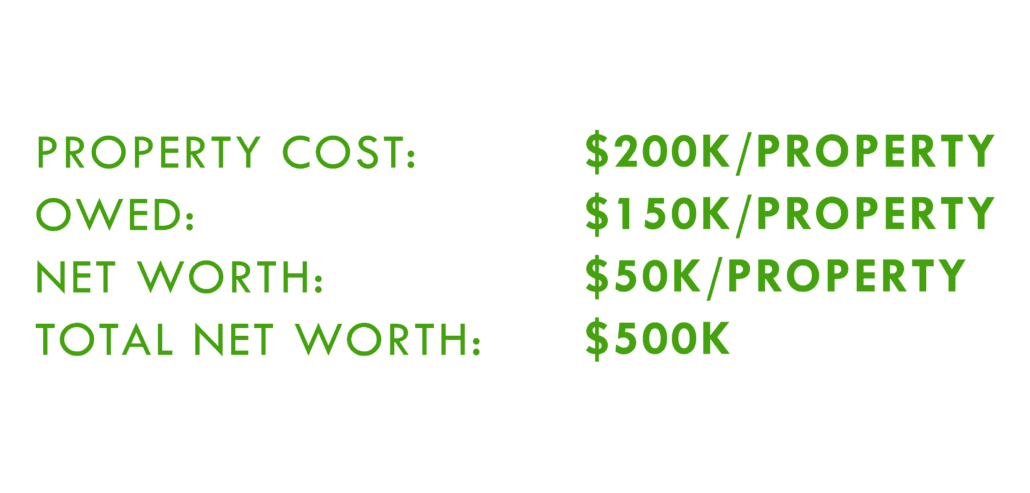
In this example, we’ll look at properties with a value of $200,000. That number is spot on for some regions, and very low for others. Remember, you can use these same equations and concepts no matter what actual price range you’re dealing with.

Let’s say we’re using BRRRR and looking at $200,000 properties. You can get a loan for $150,000 per property (which means you only owe $150,000 on each house).

Each property adds $50,000 in net worth to your portfolio. So ten properties in three years automatically builds you $500,000 in net worth.

Also, these rental properties will add up to $800/month in cash flow (more on cash flow in the next section).

Chart of property costs, amount owed, and net worth. Total net worth is $500k.

How to Use Cash Flow

If you don’t need the cash flow immediately, you can use it to pay down the loans. This way, you own the houses free and clear. When you do retire, you have all that equity in your portfolio, plus a higher monthly cash flow.

Next, we’ll dig into the details of cash flow and how it can help you retire early.

Retire Early with Real Estate – How to Make Cash Flow Work for You

We’re all about the money and leverage side of real estate. We want you to understand the numbers behind the mortgages so you can reach your goals and get out of the loans faster. 

To retire early at 40+, it’s important to look at some key numbers.

Evaluating Cash Flow When You Start Investing in Real Estate at 40

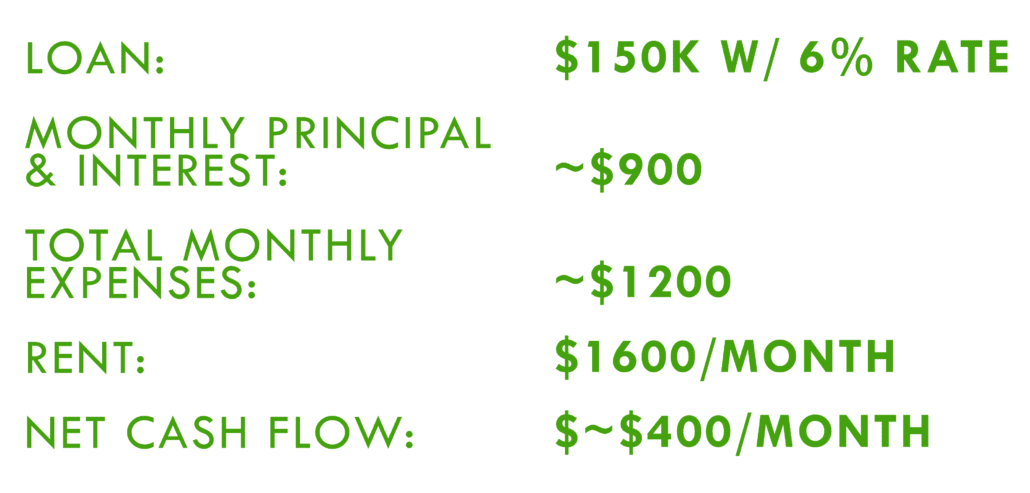
Let’s look at an example property that has a loan for $150,000 and an interest rate of 6%. 

In this case, your monthly principal and interest payment will be $899.33.

Once you add taxes, insurance, and other costs, you’ll be at $1,184.33 in expenses.

If you’re in an area where you’re finding a $200,000, 3-bedroom 2-bath property, you should be able to reasonably rent for $1,600.

With that rent, we’d have a net total of $415.67/month coming into the property.

Chart showing loan amount and rate, monthly principal and interest, total expenses, and rent. Net cash flow is around $400 per month.

How Should You Use the Cash Flow?

If you’re nearing retirement age and don’t need to pocket the cash flow on your new properties, there are some options to make that money work for you.

By using the income from your rentals, you can get the properties completely paid off. So once you finally retire, you’ll have several options:

  • Sell off the houses
  • Take out equity loans to buy more real estate or supplement retirement income
  • Get higher cash flow on each property with no loan payments

Increasing Cash Flow to Retire Early with Real Estate

If you use the cash flow on properties pre-retirement to pay down the mortgages, you can retire early (and with more money!).

Let’s round our $415.67/month net income down to $400. So instead of taking that $400 and putting it in your pocket, let’s see what it looks like to pay down an extra $400 on your mortgage every month. 

Instead of paying around $1,200 toward your loan plus insurance and taxes, you’ll be doing around $1,600/month total. 

This will cut your mortgage down to 14 years. So even if you’re 50, you can own these properties free and clear by the time you’re 65. 

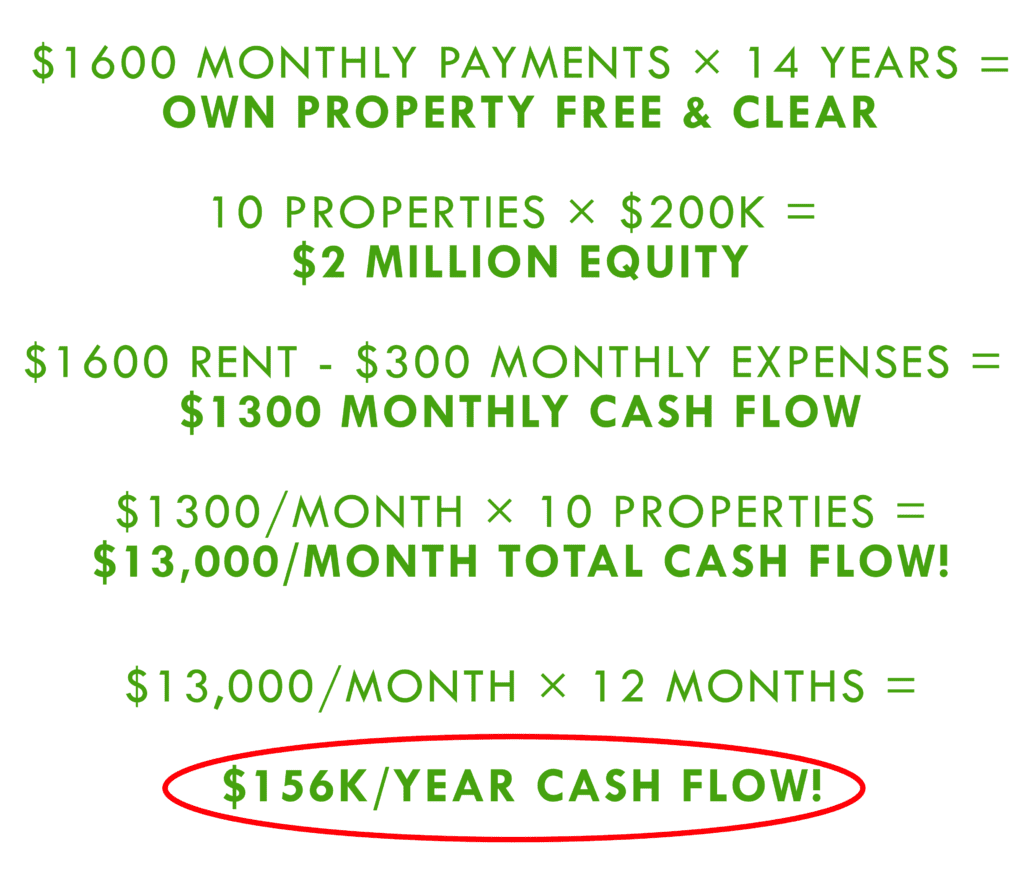
And once all the houses are paid off, you’ll automatically have:

  • $2 million in equity.
  • $1,300/month income per property. (You no longer have to pay principal or interest, just taxes and insurance.)

$1,300/month per property equals $13,000/month total across 10 properties. That’s an annual income of $156,000/year. While being retired!

Chart showing the math to find annual cash flow. Annual cash flow is $156k.

Long-Term Wealth in Real Estate Over 40

Once the houses are paid off, the only work left to do is upkeep on the properties. A small price to pay to make over 150k every year you’re retired! 

These calculations, of course, are in “today’s” money. Inflation will continue at a steady rate, so rents will go up and home values will go up. But all costs will rise over time, so these amounts will “feel” about the same.

It’s never too late to start investing in real estate.

Real Estate Investing for 40+ Beginners with No Money

Ten properties in three years. Paying down the loans so you own them free and clear by retirement. It really is great, but…

How can you start with no money?

BRRRR

BRRRR stands for Buy, Rehab, Rent, Refinance, Repeat. 

You buy the same type of properties as fix-and-flippers, but instead of selling them, you rent. They’re properties from wholesalers that are listed undermarket.

These properties require quite a bit of work to fix up, but they have the opportunity for the highest cash flow.

Subject To

A subject to is when you take ownership of someone’s property without taking out a loan. You make all payments, but the previous owner keeps their mortgage on it.

Subject tos are a great way to get into a property for little money – this is especially important since money is tightening in the real estate lending world. This investment technique has been less popular in recent years, but with the market turning, they’ll be coming back strong in the next year or two.

The Value of No Money Down Investing for Soon-To-Be Retirees

You don’t want to tap into your retirement or savings with your real estate investments – you want to add to them.

Look into BRRRR, Subject Tos, and other no money down investment techniques. This is the path to adding $2 million to your net worth without spending any money.

Real Estate Investing for Beginners in a Recession

A recession can cause unease for people nearing retirement – and people who are considering any major investments.

So why is this the best time to get into real estate investing? Even for older people?

Looking Back at the Great Recession

If you had bought the homes real estate investors did in 2010, you’d be retired by now.

Our current market is beginning to look a bit like 2008-2009 – a recession coming on, inflation hitting, the money supply tightening. Which means there will be more homes available at a discount.

Consumer debt is increasing. Especially after the housing blitz we’re just getting out of, it will be harder for homeowners to keep up on payments. When people need to move, it will be harder for them to sell. People get stuck with houses they can’t afford. 

For real estate investors, that means there’s more inventory, at lower prices.

Using The Recession to Increase Net Worth

Buy soon, when prices are down and inventory is high. In the future, rates will come down and prices will go back up. So that plan that offers $2 million of net worth could potentially double or triple.

In 2010, we helped people use the same retirement real estate investment plan outlined in this article.

One client bought ten properties that year. Since then, his real estate has quadrupled in value, and ten years later, he owns eight of the properties free and clear.

This is the time. You don’t want to buy when prices are high and sellers have control. Jump in and buy now to get the deals that will truly create wealth and help you achieve the retirement you want.

Start Real Estate Investing at 40 – Where to Go From Here?

Whether you’re ready to kickstart your investment career now or not, the best place to start is to get educated.

It doesn’t matter if you’re 30, 40, or 50 years old. Reach out to us with specific questions, or any help starting your plan for retirement at info@hardmoneymike.com or HardMoneyMike.com.

Visit these links for a BRRRR investment guide and more information on no money down investing.

Where Do You Find a Hard Money Bridge Loan Lender?

Does every hard money lender do bridge loans? Where do you find a hard money bridge loan lender?

A lot of people use the term bridge loan interchangeably with gap funding or hard money, but a true bridge loan is slightly different. They’re shorter-term than a hard money loan, and they’re typically less expensive because of that.

Is a Bridge Loan Different from a Hard Money Loan?

A hard money loan is longer and broader than a bridge loan.

  • The average bridge loan lasts 30 to 45 days. Hard money loans can last up to a year or longer.
  • Bridge loans get you from one property to the next. Hard money focuses more on a single project.
  • Bridge loans get paid when your old property sells. Hard money loans get paid when you refinance or sell the property the loan was originally for.
  • A bridge loan is used as temporary funds to close on a house. A hard money loan can be used as a more general budget for a purchase. Many come with the option for escrows to fix up the property over time.

Typically bridge loans are used for 3 situations in real estate investing. When you:

  1. Are buying a new property and already have one listed for sale
  2. Need to cover down payment on a new property
  3. Find a great deal but your bank’s financing won’t be ready in time.

What Lender Give Bridge Loans?

To find these quick, short loans, a small local lender (like Hard Money Mike) will be your best and fastest option. Smaller hard money lenders prefer working with deals that provide good, safe returns. Bridge loans do exactly that.

A bigger hard money lender will do a bridge loan, too. But they may take up to four weeks to close, which often defeats the purpose of true bridge lending.

You can also get bridge loans from some banks. Not big, national banks, but many local banks and credit unions who work with real estate investors may do bridge loans, too. Banks usually offer the cheapest bridge loans, but can take 3 – 4 weeks or longer.

Ask around to hard money bridge loan lenders you know to learn their pricing and see if it’s worth it. You can use our free loan optimizer to find out if you can get a good deal on bridge loans near you.

Read the full article here.

Watch the video here:

BRRRR Is Not Dead: How to Invest in Real Estate in an Inflation Market

When inflation hits, BRRRR does not die.

Real estate investment in general is extremely money-dependent. BRRRR in particular totally relies on the availability of funds.

So does that mean BRRRR dies when inflation hits and money tightens?

Absolutely not. You can be successful with BRRRR even during times of uncertainty. But that doesn’t mean BRRRR will look exactly the same as it did in a hot market.

Here’s what to know about BRRRR investments during inflation.

What Does BRRRR Mean?

First, let’s start with the basics. What does BRRRR mean? Your understanding of BRRRR will determine your success when inflation hits.

BRRRR comes down to two key factors.

1) Buying Undermarket Properties

Buying undermarket properties is the crux of BRRRR.

This important point has been confusing to people in the last few years. That’s because truly good undermarket properties have been hard to find.

We’ve been seeing people buy at 80-85% of a property’s ARV. In the near future, those values will come down.

Back in 2010, people were able to buy properties for 60-65% of the ARV. We’re hoping that’s where this next market will take real estate investors.

So, what does BRRRR mean? First of all, it means buying undermarket properties. And with inflation, lower priced BRRRR properties will be coming back.

2) Using a Two-Loan Strategy

The other foundational concept in BRRRR is its two-step loan process.

The whole point of BRRRR is to get into properties with little to no money down. To do this, you need two loans – one to acquire it, and one to hold it long-term. 

Once you own the property (using the first loan), you can refinance it using the appraised value (via the second loan).

If you can buy a property undermarket (with private money) and own it, you capture the equity of the house when you refinance it.

Instead of pulling more money from your pocket for your next deal, you can use the equity you create with one BRRRR to buy more real estate – even with inflation.

Learning More About What BRRRR Means

BRRRR means two things: buying undermarket real estate, and utilizing two loans to do it.

We’ve been doing BRRRR for over 15 years – before this strategy was even called “BRRRR.” For more on BRRRR fundamentals, check out these YouTube videos, or reach out to us anytime at HardMoneyMike.com.

BRRRR In an Inflationary Market

For real estate investors, including BRRRR, inflation means money tightens up.

Money tightening means there’s less money for all real estate investors. The federal government makes money harder to get to slow down spending.

So how can you expect these effects of inflation to impact BRRRR?

How an Inflationary Market Changes BRRRR Lender Requirements

In the lending world, money tightening looks like lower loan-to-values. Maybe your hard money lender used to give you 75% of the anticipated value of the home, but now they’d give 70%. 

LTVs are tightening not just on the front-end BRRRR loan, but the back-end refinance as well. Lenders are:

  • Tightening their cash out requirements
  • Offering lower LTVs
  • Raising income requirements
  • Expecting higher down payments
  • Requiring just plain better deals.

A big qualification to focus on is lenders’ credit score requirements. The minimum acceptable credit score has gone up by 20-40 points. 

If your credit is on the border, your main priority should be to raise your score. There’s less money out there. You want to be one of the people who can get leverage once property prices go down.

BRRRR Lenders and Equity in Inflationary Times

Lenders want to make sure they’re lending to the best of the best. They’re concerned with equity. 

Prices are going down. So if they lend at 70% LTV, then in 6 months home prices go down 10%, but then that 70% is no longer 70%. 

So lenders will be more conservative with their LTVs. Money in general will be more conservative during this time. Eventually, we’ll land at a “new normal,” and everyone in the money world can work off the same level. For now, things are heading down in an unpredictable way, so money will be harder to get.

If you’re investing in BRRRR in an inflationary market, stay aware of the constant changes. Rates have more than doubled this year, LTVs are going down, and the cash flow on your rental properties will take a hit.

New BRRRR Lending Options with Inflation

With rates so good over the last three to four years, all BRRRR investors were looking at one loan product – the 30-year fixed mortgage.

With rates increasing, however, you might need to look beyond the 30-year fixed loan to get into good BRRRR properties. Here are some options that can bridge your properties until rates go down.

ARMs (Adjustable-Rate Mortgages)

You can get three-, five-, or seven-year ARMs. Whichever time length you pick, the rates will be fixed during that period. Afterward, the rates become adjustable.

In rising markets, these loans aren’t that great. In declining markets, though, they can be the perfect loan to bridge you into a rental property.

You can get an ARM for .5-2% lower than a 30-year fixed mortgage. These lower rates can cash flow a property until either prices go up and you can sell, or rates go down and you can refinance.

Interest-Only Loans

With the interest-only BRRRR lending option, you don’t pay any principal for the first ten years. 

An interest-only loan is appealing right now because it keeps cash flowing. Your loan amount doesn’t go down, so it’s not a great option for the long-term. But it is a good lending option to get you into a property during this next market.

40-Year AM (Adjustable Mortgage)

A 40-year AM spreads the loan payments over 40 years instead of the 30 with a traditional fixed mortgage. This adjustable mortgage gives you lower monthly payments… and more cash flow.

What To Keep In Mind with These BRRRR Inflation Lending Options

ARMs give lower rates, 40-year AMs offer lower payments, and interest-only loans postpone the principle.

Keep in mind: these loans won’t help your equity or get a property paid down quickly. But they are good options to get into properties while values are low and funding is tight.

Remember that conditions of BRRRR are ever-changing. Get plugged into the money side of investing, and talk to lenders to see what’s available for you in inflationary times.

BRRRR Loan Requirements with Inflation

BRRRR has two loans – hard money to buy, long-term to refinance. With inflation, both BRRRR loans can expect lower LTVs. What else can you expect?

Hard Money BRRRR Loan Requirements

Many private money companies – particularly bigger, national lenders – are requiring 20% down.

Hard Money Mike is a little different. We fund using real private money, so our loans aren’t as dictated by federal rates. We still go up to 100% on financing, as long as you’re approved for your long-term loan up-front. 

Smaller lenders can give you a better advantage with BRRRR during inflation. But you should still expect many private lenders to offer lower LTVs.

Bank BRRRR Loans with Inflation

Long-term loans are decreasing, making it harder to cash out. Traditional lenders could go down to 70% or 65% LTVs, or just have tougher requirements.

Money is shrinking, so the pot of money available to you on either BRRRR loan is shrinking.

The Plus Side of BRRRR and Inflation

What’s the good in all of this? If you’re in a bad financial position, you’ll have a hard time continuing your real estate career in inflationary times.

But, if you’re in a good position, you’ll be able to find fantastic properties in your pricepoint. And you’ll be able to find them for 20-40% less money than you could a year ago.

Don’t fight what’s happening with the economy – figure out how to use it.

Understand lending requirements now. If you get into a BRRRR, fix it fast and refinance fast. Figure out your BRRRR’s long-term loan first before you look for a short-term loan.

Things are changing rapidly in the real estate investment world. Get yourself in the best position to be able to work with it.

Alternatives to BRRRR in 2022

We’re probably three to six months out from the really cheap homes getting on the market. How can you finance BRRRRs as values go down?

BRRRRs are about getting into value-add properties with little to no money down. But as we’ve mentioned, getting into the properties will be the hard part with money tightening. 

Will there be any good alternatives to BRRRR in 2022?

Subject Tos As an Alternative to BRRRR with Inflation

Here’s another way to look at rental properties with a BRRRR spirit: 

What if you could take over someone’s loan and house with no money down, no credit or other requirements, 100% financing, and a great rate?

That’s what subject tos are.

You’ll see more and more subject tos popping up soon. Maybe someone bought their home at 100% last year, but values have come down 10-15% so they can’t sell without losing money or putting more in. People don’t want to go through foreclosure, so in a situation like this, they’d be interested in a subject to.

You can take over the mortgage and put the home in your name. You can do it properly, through title, and create a rental property using someone else’s financing. 

This method doesn’t require your income, your credit, or any other qualifications. It only requires a secure set-up, and for you to make the payments on the mortgage.

This is a great way to purchase rental properties as an alternative to BRRRR in 2022 if you don’t have leverage.

Owner Carries in 2022

An owner carry can happen when the seller owns a property free and clear. In this situation, the owner takes on the mortgage.

The seller would likely plan to invest the money they get when the house sells. But the stock market is up and down, and banks only offer 2% maximum interest rates in CDs and accounts. 

For the owner, carrying the mortgage when they sell to you is a way to double or triple their interest rate, secured by an asset they already know.

For you, an owner carry is easier, cheaper money. You won’t find a 5% interest rate, with 100% financing and no credit check anywhere else.

Open-Minded Financing Alternatives During Inflation

There’s creative financing available in the real estate investment world. 

Whether it’s subject tos, owner carries, or OPM relationships, it’s important to look always into your options for doing zero down investments. Especially now that BRRRR loans are less likely to cover 100% financing.

BRRRR Is Not Dead During Inflation

BRRRR isn’t dead! But it may look different.

This is the best time to get prepared – before the housing market completely dips. We can help you get ready.

Whether you have questions about setting up subject tos, or you’re wanting to jump into BRRRR when prices drop, we can help. 

Reach out to us on Facebook, or email us at info@hardmoneymike.com

Use us as a resource – this is the time to be money prepared.

Happy Investing.

How to Set Up Your BRRRR Lenders

People who win at BRRRR understand the two most important aspects of the process: getting properties undermarket, and organizing their lenders early on.

Lenders are an important member of your investment team. Here’s how to get them ready for your BRRRR investments.

BRRRR Lender Options

You’ll have a hard money or private money lender up-front. Then, in the second half of the project, you’ll have a more conventional lender with a traditional loan.

This traditional loan is usually 30-year with fixed rates, but comes with some constraints. You’re limited to ten properties with this kind of loan (including your own home). There’s also usually a limit on loan-to-value ratio, and conventional loans won’t let you put a loan in an LLC’s name.

Another option for this second loan is DSCR no-income loans. DSCR loans come in a variety of options: five- or seven-year ARMs, standard 30-year fixed mortgages, and more. Successful BRRRR investors know all their options for refinancing.

Set Your Lenders Up Ahead of Time

People who win at BRRRR set up all their lenders before they jump into a deal.

The amount loaned for the purchase and for rehab can very a lot from lender to lender. Good investors will always know how much their hard money lenders will give them.

Hard Money Mike, for example, does a lot of 100% loans if the cost is 75% less than ARV because we know the investor can easily refinance out. We know we can set them up with a rate-and-term refinance, and they’ll have no money out-of-pocket.

BRRRR winners don’t get into a property, get it fixed up, and then figure out the long-term loan. Winners figure out first whether they can get the cash out they need, and how.

Smart BRRRR investors have a pool of lenders they work with. They know what each lender can offer, and which will best fit their current strategy, ability, and deal.

Read the full article here.

Watch the video here:

Loans for Investing with Rising Inflation: What Should You Expect?

With rising inflation, how will your loans for investing be impacted?

In the past few years, everyone with money rushed into the real estate industry. All that money flowed freely, making real estate investing relatively easy and cheap.

But with rising inflation, that money is now leaving. Here are some changes you can expect around loans for investing.

What Does a Rising Federal Fund Rate Mean?

To combat inflation, the Fed has started raising their rates. They do this to raise the cost of credit, making less money available across the board.

And obviously, this affects us as real estate investors.

When interest rates rise, money tightens up. There’s less of it available for everyone, and lenders adopt stricter requirements. 

While this makes loans for investing harder to get, it also means there will be less competition. Many current investors won’t be able to qualify for loans for investing with rising inflation.

What Will Investing Look Like with Rising Inflation?

It’s hard to say when money will start coming into the real estate market again. Lenders don’t know where exactly home prices are going. And property values are one of the main factors that decides the availability of funds.

But while everyone else is running out of the real estate market, you want to be running in. Why? Because that’s when prices will be the lowest. If you have the leverage to get into properties at low prices, you can refinance when interest rates come down. This is how you capture the wealth real estate investing offers.

This is the time you want to buy, yet it’s also the time where loans for investing are hardest to come by.

You’ll need to be prepared and qualified to take advantage of the upcoming market.

Read the full article here.

Watch the video here:

What Formula Do Lenders Use for DSCR Loans?

An important part of considering a DSCR loan is understanding the DSCR calculation. All lenders will look at this formula for DSCR loans.

Let’s go through and look at the numbers to find out if your property has enough cash flow for a DSCR loan.

Income & Expenses

The number one thing DSCR lenders look at is income.

For this example, let’s say our rent is $1,000 per month.

The next thing they look at is expenses.

They want to make sure your income more than covers your total costs. They’ll look at: mortgage payments, taxes, insurance, and HOA. Right now, they don’t look at property management costs, but that could change in the future.

Let’s fill out these numbers for our example property:

Table. Title: "DSCR Formula." Rent: $1000. An itemized list of expenses totaling $850.

So, the total expenses for this property are $850. Right away, we can see that income more than covers expenses, and this property cash flows $150/month.

Applying the DSCR Formula

Then, the equation lenders will do to determine this cash flow will be:

Income  ÷  Expenses  =  Cash Flow Rate

Or, in this case:

1000  ÷  850  =  1.17+

Lenders are looking for a positive cash flow. They want properties with:

  • Bare minimum: One-to-one. This means your rent at least covers your costs. (Example: Rent is $1000 and your monthly expenses on the property is $1000).
  • Better: 1+
  • Best: 1.25+

Download our free spreadsheet to fill out this formula for your properties to see if they’d qualify for a DSCR loan.

Read the full article here.

Watch the full video here: