
Credit Card Bridge Loan: Get Cheaper Financing
Credit Card Bridge Loan: Get Cheaper Financing today! Getting a real estate loan is not only about finding a lender. Your credit score can also change the loan you get. In fact, a few points may mean a better rate, fewer fees, or a lower down payment.
That is where a Credit Card Bridge Loan: Get Cheaper Financing strategy may help.
A credit card bridge loan is a short-term loan used to pay down credit card balances before you apply for longer-term financing. As a result, your credit usage may drop. Then, once the lower balances report to the credit bureaus, your credit score may improve.
The goal is simple: temporarily move expensive credit card debt out of the way so you can qualify for better financing.
What Is a Credit Card Bridge Loan?
A credit card bridge loan is short-term money used to pay down credit cards before you apply for another loan.
For example, a real estate investor may use credit cards to pay for materials, repairs, or other costs on a fix and flip. Because of this, the cards may have high balances when the investor needs the next loan.
Instead of applying with those high balances showing on the credit report, the investor may use a bridge loan to pay them down first. Then, after the lower balances report, the investor can apply for the new financing.
Finally, when the new loan or refinance closes, the investor can use the proceeds to pay back the bridge loan.
So, the bridge loan is not meant to become long-term debt. Instead, it is designed to bridge the gap between high credit card balances today and better financing tomorrow.
Why Does Credit Card Debt Matter So Much?
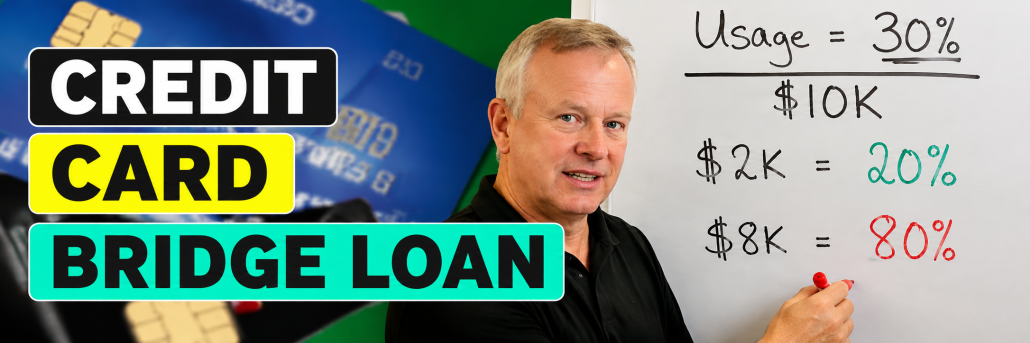
Credit card balances can affect your credit score because credit scoring models look at your credit utilization, also called credit usage.
Credit utilization compares how much revolving credit you are using with how much you have available.
For example, suppose you have $10,000 of available credit and owe $2,000.
Your utilization is:
$2,000 ÷ $10,000 = 20%
Now suppose you use those same cards to help finish a flip. Your balances rise to $8,000.
Now your utilization is:
$8,000 ÷ $10,000 = 80%
Nothing else about you changed. You are the same investor. You have the same income, experience, properties, and business.
However, your credit report now shows much higher credit usage. Therefore, your credit score may fall.
Why Can This Be a Problem for Real Estate Investors?
Real estate investors often use credit cards differently from other borrowers.
For example, you may put $8,000 on cards for cabinets, flooring, appliances, or last-minute repairs. You know the property will eventually sell or refinance. Therefore, you may not worry much about carrying that balance for a short time.
However, your credit score does not know why you spent the money.
It only sees the balance.
That can create a problem when you want to buy your next property, refinance a rental, or move a flip into a DSCR loan.
In the source example, high card usage can occur because an investor used personal-reporting cards to cover materials and extra project costs before the flip sold.
How Does a Credit Card Bridge Loan Work?
The process can be fairly simple.
First, review your credit card balances and available limits. Next, find out which cards are hurting your credit score the most. Then, determine how much you may need to pay down.
After that, use short-term funds to lower those balances before the cards report again.
Once the lower balances show on your credit report, check your updated credit score. Then, if your score reaches the range you need, apply for the new financing.
Finally, after the new loan closes, pay off the short-term bridge loan as planned.
In simple terms:
High Card Balances → Bridge Loan → Lower Card Balances → Updated Credit → Apply for Better Financing → Pay Off Bridge
Timing Can Be Just as Important as the Paydown
Paying down your cards is only part of the strategy. You also need to understand when the lower balance will report.
Credit cards generally report based around their statement cycles. However, different cards may report at different times.
For example, imagine you pay down a card on Monday. The statement closes Wednesday. Then the new balance reports a few days later.
Once the credit bureaus receive the lower balance, your credit score can reflect the new information.
Therefore, you do not want to pay down a card and immediately apply for financing before the new balance appears on your credit report.
Instead, you want to plan the paydown around the reporting cycle whenever possible.
Run a Credit Score Simulation First
Before borrowing money to pay down your cards, find out whether the strategy is likely to help.
Many credit services offer credit score simulators. These tools let you test different situations.
For example, you might enter:
What happens if I pay $5,000 off this card?
Or:
What happens if I pay all my cards below a certain balance?
The simulator can then estimate how those changes could affect your credit score.
Of course, a simulation is not a guarantee. Still, it can give you useful information before you make a move.
Most importantly, it helps answer the big question:
Will paying down these cards improve my score enough to help me qualify for better financing?
The transcript recommends running this type of simulation before using a bridge strategy because, if the expected score improvement does not help you qualify or get better terms, the bridge may not make sense.
Example: A Fix and Flip Investor
Let’s say you just finished renovating a property.
However, the home is taking longer to sell than you expected. Meanwhile, you have $20,000 sitting on personal credit cards from materials and other project expenses.
Now you decide to keep the property as a rental instead.
So, you apply for a DSCR loan.
There is one problem. Your credit card balances pushed your credit usage higher, and your score dropped. As a result, the DSCR loan you want may cost more, or you may not qualify for it yet.
A credit card bridge loan may give you another path.
You temporarily pay down the cards. Next, you wait for the new balances to report. Then you apply for the DSCR loan with the updated credit profile.
Finally, if the DSCR refinance closes as planned, you can pay off the bridge loan.
The transcript describes this same basic situation: a flip is not selling, the investor wants to turn it into a rental, but credit card balances from the project are affecting the investor’s score.
How Can a Higher Credit Score Get You Cheaper Financing?
A higher credit score does not guarantee a better loan. However, it can open more doors.
For example, a stronger score may help you qualify with more lenders. In addition, it may help you reach a better pricing tier.
That can mean a lower interest rate, fewer points, a smaller down payment, or better loan terms.
Even a small improvement can matter if it moves you across a lender’s credit-score cutoff.
For example, suppose one lender has different pricing for a 679 score and a 680 score. Moving only one point could put you into a different pricing level.
Therefore, you should not think about your credit score as just one big number.
Instead, ask:
What score do I need for the loan I want?
Then work backward from there.
The Goal Is Not to Add More Debt
This part is important.
A credit card bridge loan should not simply move debt around without a plan.
Instead, it should have a clear purpose and a clear exit.
You are using short-term money to get from Point A to Point B.
Point A: Your cards have high balances and your credit score may be holding back your financing.
Point B: Your balances report lower, your credit profile improves, and you can move into financing that better fits your long-term plan.
Then, the bridge gets paid off.
Therefore, before using this strategy, know exactly how you plan to repay the bridge loan.
Does the Money Have to Come From a Bridge Lender?
No.
The idea is more important than the name of the loan.
For example, you may have your own cash available. You may also have access to short-term funds from another source.
The key is that you use the money temporarily to lower the credit card balances, improve the financing picture, and then repay the temporary funds when your longer-term financing closes.
In fact, the transcript points out that the temporary funds could come from a lender, your own money, or even a friend or family member.
When Does a Credit Card Bridge Loan Make Sense?
A credit card bridge loan may make sense when you have high card balances that are hurting your credit score, you expect paying them down to improve your financing options, and you have a clear way to repay the bridge.
For example, you might be trying to:
- Qualify for your next fix and flip loan.
- Refinance a completed flip into a DSCR rental loan.
- Qualify for better loan pricing.
- Reduce the amount of cash a lender requires.
- Reach a lender’s minimum credit score.
- Move high-interest card balances into better long-term financing.
However, the numbers still need to work.
If the bridge costs $3,000 but only saves you $500 on the new loan, it probably does not make sense.
On the other hand, if spending $3,000 helps you qualify for financing that saves $10,000, lowers your required cash, or allows you to move forward with another profitable project, it may be worth considering.
Therefore, always compare the cost of the bridge with the value of the financing it may help you reach.
Could You Avoid This Problem in the Future?
Possibly.
One option is to be careful about which credit cards you use for your real estate business.
Some business credit cards may not report normal monthly balances to your personal credit report. Therefore, using the right business cards for project expenses may help keep large business purchases from affecting personal credit utilization.
However, card reporting policies vary. So, always confirm how a card reports before depending on this strategy.
You can also watch your credit before you need financing rather than waiting until you are ready to apply.
After all, it is much easier to fix a credit issue when you have 30 or 60 days than when you need to close a loan next Friday.
Frequently Asked Questions
How fast can a credit card bridge loan help my credit score?
It depends on when your credit cards report the new balances and what else appears on your credit report. Therefore, there is no guaranteed number of days or points.
However, because credit card balances update as creditors report new information, paying balances down before the next reporting cycle may allow the lower balances to show relatively quickly.
Will paying off my credit cards guarantee my score goes up?
No. Credit scores depend on several factors. Therefore, no one should promise an exact increase.
Instead, run a credit simulation first and see how a lower balance may affect your situation.
Do I have to pay every card to zero?
Not always.
Your goal may simply be to reduce utilization enough to reach the credit range you need. Therefore, a simulation can help you decide which cards to pay down and by how much.
Can this help with a DSCR loan?
Potentially, yes. If credit utilization is keeping your score below a lender’s requirement or a better pricing tier, lowering your balances may help your financing options.
Can it help with a fix and flip loan?
Potentially. Fix and flip lenders may use credit scores when determining approval, pricing, leverage, or other terms. Therefore, a stronger credit profile may give you more choices.
Is a credit card bridge loan a long-term loan?
It should be viewed as short-term financing with a planned exit. The goal is to bridge you from your current credit situation to the financing you actually want.
A Bridge to Better Financing
Sometimes the problem is not the property.
It is not the deal.
It is not your income.
And it may not even be your experience.
Sometimes your credit cards simply have high balances at the wrong time.
That is common for real estate investors. After all, projects cost money, repairs go over budget, and properties do not always sell or refinance exactly when we expect.
However, you may have options.
A credit card bridge loan can temporarily lower your card balances so your credit report better reflects where you want to be when you apply for financing.
So, before accepting a high rate, putting more money down, or walking away from a loan, look at your credit utilization.
Then run the numbers.
Sometimes a short bridge can help you reach much cheaper financing on the other side.
Watch my most recent video to find out more about: Credit Card Bridge Loan: Get Cheaper Financing








Leave a Reply
Want to join the discussion?Feel free to contribute!