Hard Money Loan Basics: Numbers to Know

The ultimate beginner’s guide to basic hard money loan numbers to know (AKA, your guide to wealth in real estate investing).

There’s money in the money when it comes to real estate investing. But the numbers surrounding hard money loans can be confusing, especially for beginners.

Many investors don’t want to learn these numbers. Just by reading this guide, you’ll be way ahead of the game.

Let’s go over these basic numbers to get you one step closer to being a real estate expert:

Hard Money Loans – Knowing the Basics

As a beginner investor, you need to know the basics about hard money loans.

The two most basic hard money questions you need to know the answers to are:

  1. What’s the difference between loan-to-value and ARV? 
  2. How do you calculate them?

Know the Basics: Loan-to-Value

Loan-to-Value, LTV, involves the:

  • appraised value of a property
  • as it sits right now
  • with nothing changed about it.

As a real estate investor, if a property costs $100,000 as it sits, you know you’re going to put work into it and make it worth more. But that as-is value, the $100,000, is what lenders base their loan amount on. 

Know the Basics: After Repair Value

After Repair Value (ARV) is used more by hard money lenders and the real estate investment world. Banks and traditional lenders more often use LTV.

Because in real estate investing, we’re basing our numbers on what you can do to the property. What can the value be once you fix it up? That’s the number that determines profit, so that number is more important for hard money lenders.

ARV is the target value of what the house will be worth after all your renovations. This ARV should always be higher than the current price of the house when you buy it.

Calculating ARV and LTV

Let’s say you found an undermarket property that’s selling for $100,000. If a lender says, “We’ll loan you 75%,” that could mean two things, and you’ll want to know the difference.

First, if they’re a bank, they’re likely talking about 75% of the value. In this example, that would be:

$100,000  ×  75%  =  $75,000 loan

Hard money lenders will care more about the value of the home after repairs, so they go off ARV. If they loan you 75%, that would be:

$150,000  ×  75%  =  $112,500 loan

If a loan is based on ARV, lenders might want to know – what are you doing to the property? Different renovations will affect the value of the property in different ways. What you will do and the quality of the work will affect the ARV.

Know the basics about LTV and ARV, and your hard money experience will be much smoother.

Hard Money Loan Requirements

What are the requirements for a hard money loan?

What will hard money lenders lend you, and what does it take to get it? Knowing these numbers in advance will help you stay on track to getting profitable deals.

The majority of hard money lenders will lend up to 75% of the ARV. 

So, let’s say a property will be worth $100,000 after all repairs, and a lender offers you 75% of that ARV. You’ll receive a loan for $75,000.

Is that enough? Now it’s up to you to crunch the numbers and see if you meet these hard money loan requirements. Will that $75,000 cover everything – the purchase, the rehab, etc.? And if it doesn’t – how much do you need to bring in? Can you make that work?

What Expenses Does a Hard Money Loan Cover?

A hard money loan covers:

  1. The purchase of a property.
  2. The rehab of that property.

100% financing is possible with a hard money loan, but it’s dependent on a lot of things – your credit score, investing experience, relationship with the lender, and more.

Let’s see an example of how the numbers on that $75,000 loan could work out to cover the flip 100%:

Loan:  $75,000

Purchase Price:  $50,000

Rehab: $25,000

If it’s possible to keep rehab costs at $25,000, you could get this $50,000 property 100% financed by a hard money loan, if the ARV is $100,000.

But let’s say rehab ends up costing $35,000. The total cost of the project would be $85,000, but your loan only covers $75,000. You’d have to come up with that extra $10,000 somewhere else – either from an alternative lender or from your own pocket.

Know the numbers to help you plan ahead with your hard money loan. If you know up-front that rehab will cost $35,000 on this property, you’ll know to only go through with the deal if you’re able to bring in that additional $10,000.

The 75% Rule Hard Money Loan Requirement

You can learn ahead of time whether your project can be 100% covered by a hard money loan. Just follow the 75% rule: make sure the costs of your project are under 75% of the property’s ARV.

Hard Money Loans Calculations

We’ve gone over some of the basics, but there are a few more hard money loans calculations to know.

Hard money lenders – especially national lenders – have two important numbers they go by. 

First, 75% of the ARV is the maximum they’ll lend you.

Second is a more specific breakdown of how that money will be used, usually referred to as 90/100 or 80/100.

Know the Numbers: What Is the 90/100 Number in a Hard Money Loan?

This number is usually around 90/100, but lenders can tighten down to 80/100 or lower. But what does this number mean?

The first number is the percentage of the loan that goes toward the purchase. The second number is the percentage that goes toward rehab. The higher the numbers, the less of your own money you have to put down.

In the case of 90/100, that means your loan will cover 90% of the purchase and 100% of the rehab.

But whatever that calculation is, it still has to be less than 75% of the ARV. Here’s an example

90/100 Calculation Example

Let’s use the numbers from our last example to look at a 90/100 loan. We’ll take 90% of the purchase price.

Purchase Price: $50,000

50,000  ×  90%  =  $45,000

So, $45,000 of your loan must go toward the purchase of the property. But since it costs $50,000 total, you’d have to bring in the additional $5,000.

Rehab: $25,000

25,000  ×  100%  =  $25,000

So, $25,000 of the loan will go toward rehab. That covers all of it, so you wouldn’t need to put any of your own cash into repairs.

So what would this 90/100 loan cover total?

$45,000  +  $25,000  =  $70,000

90/100 vs 75% Rule

But wait, that 90/100 loan example only gave you $70,000. The 75% rule on the same property said you could get a $75,000 loan. So which is it?

The 75% rule (hard money lenders loaning 75% of the ARV of a property) isn’t a guaranteed loan amount. It’s the maximum loan amount.

This maximum rule becomes more relevant as the deals get riskier.

Lenders don’t like risky deals because there’s a good chance you’ll lose money or only breakeven. 

Here’s how our previous example could become much riskier and the 75% rule would become more important:

Let’s say we have that same property with an ARV of $100,000. But this time, the purchase price is bigger.

Purchase Price: $60,000

Rehab: $25,000

Now, let’s apply the 90/100 principle:

60,000  ×  90%  =  $54,000 loan for purchase

25,000  ×  100%  =  $25,000 loan for rehab

Total loan amount  =  $79,000

So if a loan covered 90% of this purchase price plus all of the repair costs, the total loan would need to be $79,000.

But the 75% rule says your max loan for this property with a $100,000 ARV can only be $75,000. So, in this case, you’d get the loan for $75,000, and be stuck bringing in that extra $4,000 the loan didn’t cover.

Why the 75% Rule?

The 75% rule protects you from the other costs from your project. You’ll still have to pay for selling costs, overhead, and loan fees. Yet you’ll still want at least 10% – 15% profit.

If your loan by itself is any more than 75% of your ARV, you’d be set up to make little to no money.

Lenders want to stop you before you get started if they can see there’s a good chance you won’t make a profit. They want to encourage good deals, and discourage deals people won’t be able to follow through on.

The bottom line: remember there are two numbers. The 75% rule is the maximum amount they’ll lend you overall. The 90/100 (or 80/100, etc) tells you the amount of the loan they’ll allocate to purchase and rehab.

What If I’m Still Confused?

These hard money calculations, numbers, and requirements can be overwhelming if you’re not used to them. Luckily, you don’t have to memorize all this stuff right off the bat.

Download our deal analyzer here. With this spreadsheet, all you have to do is enter the numbers. It does the math for you to help you decide whether to pursue your deal, and how much money you’ll have to bring in if you do.

A tool like this can help you know the numbers before you go to your hard money lender. Life is easier for everyone, and more profitable for you, when you know the numbers of a hard money loan.

Calculating Hard Money Loans for BRRRR

If you’re looking at the rental side of real estate investing with BRRRR, what are the numbers you need for a hard money loan? What do you look for in a profitable flip?

BRRRR was designed to let investors get into rental flips with almost no money down. How do you do it? The 75% rule.

What does that mean, and how do we calculate it?

With BRRRR, there’s two loans involved. The first (hard money) loan is to purchase and fix up the property. And the second (bank) loan is to refinance for the long term.

To make the BRRRR process happen with no money down, you have to know ahead of time that you can keep costs under 75% of the ARV.

The Math on a BRRRR Hard Money Loan Using the 75% Rule

75% of what your property will be worth (ARV) is your cap for costs.

Let’s say you’re buying a property, and based on the neighborhood, comps, and all other appraisal considerations, the ARV is $200,000.

Using the 75% rule would give us:

200,000  ×  75%  =  $150,000

Your hard money loan could be up to $150,000. This means if all your costs for the project stay under $150,000, you don’t have to bring any money in. 

With this example, it would be doable:

Purchase Price: $125,000

Rehab: $25,000

Total cost: $150,000

If you could keep rehab costs at $25,000 for the project, all costs would be equal to the 75% ($150,000) loan we’d receive.

If we take the same example, but the purchase price was $140,000 with $25,000 of rehab costs, you’d end up putting in $15,000 of your own money. Still doable, but more expensive.

100% BRRRR Financing in the Future

As the economy turns and we begin to see more foreclosures, BRRRRs will be a great opportunity to build up a bigger real estate portfolio with no money down.

The opportunities are out there, but to do it, your costs have to be at 75% or lower. This number might tighten in the near future to 70%, but all the same rules still apply.

If you know your numbers before you buy, you can use a BRRRR hard money loan to your full advantage with zero money down.

Hard Money Calculator

A hard money calculator is another important tool to help investors know the numbers of a hard money loan.

Beginner and experienced investors alike need to know the difference between loans offered by different hard money lenders.

How Does a Hard Money Calculator Work?

Some lenders will charge higher interest rates with no points. Some will charge higher points, which are percentage points taken out for fees, but have a lower interest rate.

The numbers get complicated fast. How can you compare all this for your specific deal?

The best way to figure out these numbers is to use our loan optimizer, with a free download here

With this loan optimizer, you insert all the numbers – the loan amount, required down payment, interest rates, points, fees, etc –  from up to three different lenders. Then the calculator does all the math to show how much each loan would actually cost. 

It’s a simple way to compare lenders in your area and find the best price.

Example of a Hard Money Loan Calculator

Finding the cheapest loan for your deal can save you thousands of dollars on your project.

(Note: It’s good to shop around to find the best numbers, but don’t shop around forever! Or else you’ll never get to know a lender well enough to get preferential treatment.)

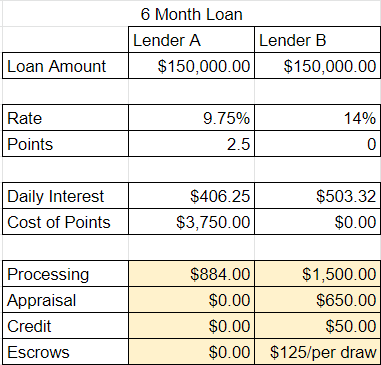
Here’s a walkthrough of how a loan optimizer might compare two lenders:

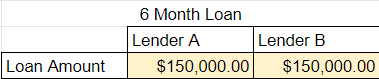
Loan Amount

Let’s say for a potential deal, you need a loan for $150,000. Both lenders we’re comparing are going to give you that full amount:

Lender A: $150,000. Lender B: $150,000

Interest Rates, Points, and Their Costs

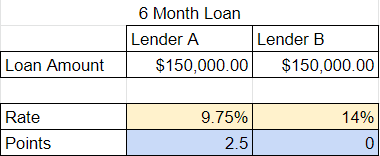
But let’s say Lender A and Lender B have different rates (interest rate) and points (percentage taken out for fees).

Lender A: Rate 9.75%, Points 2.5. Lender B: Rate 14%, Points 0

Many beginner investors look at this and think, “Well, I don’t want a lender with so many points. I don’t want to just be paying fees.” But they fail to actually do the calculations. You’ll be surprised which loan will save you the most money. 

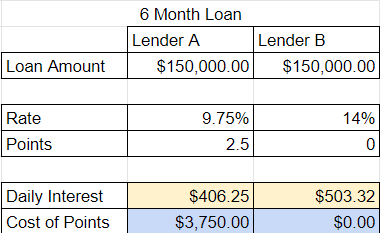
A loan optimizer will calculate the cost based on these rates and points:

Lender A: Daily Interest $406.25, Cost of Points $3,750.00. Lender B: Daily Interest $503.32, Cost of Points $0

As we can see, the daily interest combined with the cost of the points makes Lender B look like the cheaper option so far.

Other Fees

But there’s one more crucial cost we still need to take into consideration. 

Often, lenders who charge zero points up-front end up charging a lot of “junk fees” later. Here’s the example of Lender A and Lender B with all the extra fees highlighted:

Fees. Lender A: Processing $884, Appraisal $0, Credit $0, Escrows $0. Lender B: Processing $1,500, Appraisal $650, Credit $50, Escrows $125 per draw

The various fees charged by Lender B add up quickly, making Lender A suddenly look a lot better.

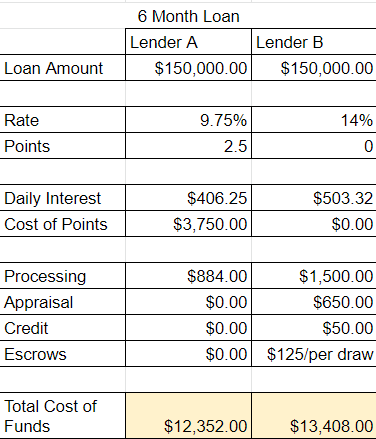
Final Costs

But let’s check with a final calculation which lender would be the cheaper choice:

Lender A: Total Cost of Funds $12,962. Lender B: Total Cost of Funds $13,408

Here’s our final calculation by our loan optimizer. By the end of the six months, we’d be paying $12,352 to Lender A, or $13,408 to Lender B.

So, Lender A, who had more points up-front, is the cheaper option – by over a thousand dollars!

Yet, if we’d judged these lenders based on our first impression of interest rate and points, we might not have gone with Lender A.

This is why it’s always important to use a loan calculating tool when shopping for hard money lenders. Know the hard money loan numbers – it can be simple! Click this link for the free download of our loan optimizer.

Know the Numbers of a Hard Money Loan

When you know the numbers, you’ll pick more profitable deals and cheaper loans.

There’s money in the money. There’s money in the numbers.

But you probably won’t become an expert in the numbers overnight.

Reach out to us at HardMoneyMike.com with questions about your deals, or with general questions about hard money numbers.

Happy Investing.

How to Boost Your Low Credit Score

It’s one thing when your low credit score is due to a lifetime of bad habits. It’s another thing entirely when a few events knock your score down. Giving a boost to a low credit score is relatively simple – anyone can do it, if they’re willing.

If your credit is just “dinged up,” there are three quick solutions to improve it.

1. Get Your Credit Balances Down

We often see investors and contractors put all renovation costs of a job on their credit cards – especially for BRRRR projects. They use more and more of their credit, which drags their score lower and lower.

This is a tempting yet dangerous pattern as a BRRRR investor. You put your money into the property from your credit card, which you expect to get back with your refinance. But if your credit score is too low, the refinance might not go as planned. With bad credit, you won’t be able to get the refinancing loan as easily or for as much money as you expected. This will make it harder to pay off the card balances you built up during the rehab.

A tip to get around this problem is to go private. If you can get a private loan that won’t show up on your credit, you can use that money to pay down your balances.

A better score will give you better rates for your long-term, credit-based financing. A lower credit score could make your loan rate a point or two higher, which could snowball into you paying an extra $50,000 to $70,000 over the life of the loan.

2. Get Authorized to Boost a Low Score

Another quick fix for a low credit score is using someone else’s good credit to help your bad credit. Find a family member or friend who has good, long established credit, and ask them to add you as an authorized user. Their good credit will show up on your report and boost your low score.

3. Pay Your Bills on Time

If you can’t keep up with your bills, that may be a sign to get rid of some of your credit cards. Some of our clients have over 20 credit cards open! Consolidate your accounts as much as possible.

But when you stop using an account, don’t close it. As long as it has a good history, an open, unused credit account will continually add a little boost to your credit.


Lenders look at credit to see how you paid people in the past as a clue to how you’ll pay them in the future. It could take you up to six months to bump up your score in the long-term. But if you don’t start now, it’ll keep getting harder to raise it. The best time to start fixing your credit is now.

Read the full article here.

Watch the video here:

Bridge Loan vs Hard Money Loan: What’s the Difference?

Though similar, there are differences to know in a bridge loan vs hard money loan.

Some lenders will use “bridge loan” and “hard money loan” interchangeably. After all, they are similar concepts, and lingo varies from lender to lender. But it’s important to know the actual definitions so you understand these terms if a lender uses them this way.

When to Use a Bridge Loan

A bridge loan is a very short-term loan – even shorter than the typical hard money loan. It helps you bridge the space between one project and another.

Let’s say you’re just finishing up a flip. The house is on the market, buyers are showing interest, and now you’d like to get another property bought so you can jump right in to your next flip.

Typically, you use the money from selling one property to buy the next one. But if you want to get that next property started before the current one is sold? That’s where a bridge loan comes in.

A true bridge loan covers up that gap between projects. It gives you the money to close on a new property before the first one is completely sold.

A bridge loan lets you overlap from an old project to a new one.

How is a Bridge Loan Different from a Hard Money Loan?

A hard money loan is longer and broader than a bridge loan.

  • The average bridge loan lasts 30 to 45 days. Hard money loans can last up to a year or longer.
  • Bridge loans get you from one property to the next. Hard money focuses more on a single project.
  • You pay off bridge loans when your old property sells. You pay off Hard money loans when you refinance or sell the property the loan was originally for.
  • You use a bridge loan as temporary funds to close on a house. You use a hard money loan as a more general budget for a purchase. Many come with the option for escrows to fix up the property over time.

Certain lenders do pure bridge loans, while others lump it all under “hard money.” Keep in mind as you’re learning the real estate investment game that a bridge loan vs hard money loan serves different purposes.

Read the full article here.

Watch the full video here:

Basics of Commercial Real Estate Investing in 2022

2022 may be the year you want to venture into commercial real estate. Apartments buildings with over five units, retail space, office buildings, and industrial areas all fall under commercial real estate.

How Do You Invest in Commercial Real Estate?

One option for commercial real estate investing is to hold or flip just as you would any single-family home. We’ve also seen a lot of people find success with another option recently: buying bigger industrial properties, flipping them, and splitting them up into separate properties to sell.

Cap Rates in Commercial Real Esate

An important number to consider in commercial real estate investing is the cap rate. All commercial properties come with a cap rate, which is the return you can expect on your investment.

For example, if you put $100,000 into a property with a 4% cap rate, you can expect a return of $4,000; this is probably an area that pays lower rent. But a $100,000 investment on an 8% cap rate will have an $8,000 return, so the property will have higher cash flow.

Generally, the higher the cap rate, the lower the value because it may be considered a riskier investment. The lower the cap rate, the higher the value because more people are more willing to put more money in.

People take lower cap rates over higher ones because they believe a lower cap rate market is more stable. It’s like when you put money into a CD – the appeal is the stability, despite the lower rate. People who look for higher cap rates prioritize return over long-term growth or stability.

Cap rates differ city-to-city and within cities. If you’re interested in commercial properties, you can talk to a commercial broker in your area to understand local cap rates.

Read the full article here.

Watch the video here:

Subject To Real Estate Investment Strategies to Build Your Portfolio

It’s a big opportunity. What are some investment strategies to make subject tos happen?

With a subject to, you buy a property subject to the seller leaving their mortgage on the property.

There are several benefits of subject tos – but how do you make it work? What are the right investment strategies to successfully get a subject to?

Subject To Strategy #1: Going Through a Proper Closing

First of all, still go through a proper closing on subject tos. You want to make sure the owner doesn’t have any other liens you don’t know about. When you take ownership, you become responsible for any existing liens on the property.

At the very least, get a title report to verify there are no liens. If you want, you can get title insurance – an extra cost but potentially worth it.

Subject To Strategy #2: Adding Your Name and Avoiding Problems with the Mortgage Company

With subject tos, some people may say you’re not allowed to take ownership and make someone else’s payments. They fear the lender may call the mortgage.

But we’ve never seen a lender ever call a mortgage in this situation.

The main reason is because the lender usually doesn’t break even with the loan until year three or four.  When a lender originates the mortgage, they buy it, so it takes at least three years of payments to get their money back.

So as long as you pay on time and don’t cause friction, the mortgage company should have no problem with you taking over. They make money every time you make a payment, so they have no reason to call it off.

Subject To Strategy #3: Negotiating with the Seller

Sometimes you’ll have to negotiate with the seller for them to go through with a subject to.

Maybe they’ll need a payment of $5,000 – $15,000 to be able to leave. Maybe they’ll include terms that they’ll only keep the mortgage on for five more years.

It’s helpful to know when a seller is in a position that they’ll want a subject to. A subject to takes place because the seller, for whatever reason, needs to sell the house but can’t. They don’t want to be stuck with the property, and they don’t want a foreclosure or missing payments to ruin their credit.

If you make their payments for around 12 months, they can usually qualify for another mortgage on another property without this one hurting them.

For more details on real estate investment strategies and setting up subject to deals, reach out to us at HardMoneyMike.com. We have plenty of experience, and we want to help you build a real estate portfolio without worrying about your credit or income.

Read the full article here.

Watch the full video here:

What Is the Meaning of BRRRR?

BRRRR winners understand the meaning of BRRRR and, just as importantly, what it doesn’t mean.

We aren’t just talking about the literal meaning: Buy, Rehab, Rent, Refinance, Repeat. We’re talking about understanding the strategy behind the BRRRR method. Successful investors understand the money side of these investments.

Types of Properties that Win at BRRRR

Foundationally, BRRRR means buying undervalued properties.

These properties have a lot of rehab needed, causing them to be valued much lower than other homes in the area. These houses are problems for someone else but opportunities for you. You can fix them up and get them in your rental pool.

We often see people who want to use the BRRRR strategy, but they buy their properties at 90% or 95% of the ARV. They buy close to retail price, and once they put the time, money, and effort into fixing up the property… They can’t even really use BRRRR.

BRRRR’s Two-Loan Strategy

BRRRR means using a two-loan strategy. At the beginning of the project, closing with a hard money bridge loan. At the end of the project, refinancing a traditional loan.

Using this strategy on an undermarket purchase captures the equity of the home to use to your advantage. If you buy a property too close to its ARV, the whole system falls apart and you lose your refinancing power.

To be successful with this two-loan plan, you have to search for undermarket properties you can get for 75% or less of the ARV. With this 75% rule, you can complete a BRRRR project with little or no money out-of-pocket.

Buying undermarket and using two strategic loans is the meaning behind BRRRR that winners fully grasp. But there’s much more to it.

What should you really look for when you buy for BRRRR?

Read the full article on BRRRR meaning here.

Watch the video here:

Why Gap Funding and Bridge Loans Will Grow Your Real Estate Business

The difference between gap funding and bridge loans – and why it matters to your real estate investments.

Gap funding, bridge loans – they sure sound similar. What’s the difference? How are each of these types of funding going to improve your business?

Both gap funding and bridge loans have the power to smooth out your real estate career and grow it to new heights.

Here’s what you’ll need to know.

Bridge Loans vs Hard Money Loans

Some lenders will use these terms interchangeably. After all, they are similar concepts, and lingo varies from lender to lender. But it’s important to know the actual definitions so you understand these terms if a lender uses them this way.

Though similar, there are differences to know in a bridge loan vs hard money loan.

What is a Bridge Loan Used For?

A bridge loan is a very short-term loan – even shorter than the typical hard money loan. It helps you bridge the space between one project and another.

Let’s say you’re just finishing up a flip. The house is on the market, buyers are showing interest, and now you’d like to get another property bought so you can jump right in to your next flip.

Typically, you use the money from selling one property to buy the next one. But if you want to get that next property started before the current one is sold? That’s where a bridge loan comes in.

A true bridge loan covers up that gap between projects. It gives you the money to close on a new property before the first one is completely sold.

A bridge loan lets you overlap from an old project to a new one.

How is a Bridge Loan Different from a Hard Money Loan?

A hard money loan is longer and broader than a bridge loan.

  • The average bridge loan lasts 30 to 45 days. Hard money loans can last up to a year or longer. 
  • Bridge loans get you from one property to the next. Hard money focuses more on a single project. 
  • Bridge loans are paid off when your old property sells. Hard money loans are paid off when you refinance or sell the property the loan was originally for.
  • A bridge loan is used as temporary funds to close on a house. A hard money loan can be used as a more general budget for a purchase. Many come with the option for escrows to fix up the property over time.

Certain lenders do pure bridge loans, while others lump it all under “hard money.” Keep in mind as you’re learning the real estate investment game that bridge loans vs hard money loans serve different purposes.

3 Ways to Use a Hard Money Bridge Loan

Some lenders might talk about hard money and bridge loans as the same – that’s okay. But it will benefit you to know the particular uses for bridge loans.

The basics of a bridge loan are that they’re used to bridge you from one project to the next. Then you pay the loan off when the first property sells. 

1. Bridge Loans to Get from One Property to the Next

The most common use of bridge loans in the hard money space is to bridge you from one property to the next.

When you have a flipped property that’s almost complete – the work is done, it’s under contract, it’s almost sold – you might want to get started on your next project without waiting for the official close.

The problem is: How do you buy a new property without the money from selling the old one? A hard money bridge loan solves that problem.

A bridge loan allows you to use the property that’s about to be sold as collateral for a new loan for a new property. Once the first property sells, some of that money is used to pay off the bridge loan. Then you own the new property free and clear.

This way of using a bridge loan is especially useful if you have a lot of cash put into one property. You don’t have to wait to get that money back after selling to start on your next investment.

2. Bridge Loans to Cover a Down Payment on a New Property

You can use an advance of the equity on a current property as the down payment for the new property through a bridge loan.

Maybe you’re about to sell one property. And you’re able to get financing for your next one… Except you can’t cover the down payment. 

In this case, you’ll probably use a bridge loan in conjunction with a hard money loan. The hard money loan covers the property cost, and the bridge loan covers the remaining down payment cost. Then that bridge loan gets paid off when you sell the old property. 

3. Bridge Loans to Close Fast

Another way you could use a bridge loan is to close faster on a new property.

Maybe you plan on using more traditional financing through a bank, but the bank loan wouldn’t be ready in time. You can use a short-term bridge loan.

This loan bridges you from the closing to the refinance. A bridge lender will help you with the initial purchase. Then once your bank (or hard money) loan is completely ready – usually several weeks or a month later – that bank loan pays off the bridge loan.

Bridge Loans in the Hard Money World

Typically bridge loans are used for 3 situations in real estate investing:

  1. When you’re buying a new property and already have one listed for sale
  2. When you need to cover down payment on a new property
  3. When you find a great deal but your bank’s financing won’t be ready in time.

Gap Funding for Real Estate Investors

So, bridge loans are different from hard money loans. But where does gap funding fit into the mix for real estate investors?

Bridge loans do bridge “gaps” in your investments. But “gap funding” is something different.

Gap funding is the small amounts that investors need throughout the course of a project in addition to the bigger loan. Examples of common gap funding situations are:

  • Down payments
  • Contractors and other fix-up costs
  • Carry costs before renting or selling
  • Interest, insurance, and other payments not included in the original cost of the property.

A bank or hard money lender will be funding the majority of your project. And when you don’t have other properties, you can use a lien (like you would for a bridge loan). But without another property, you need gap funding to cover the little costs that slip through the cracks of your primary financing.

Gap funding for real estate investors can be a loan that’s anywhere from $10,000 to $100,000. Whatever costs your primary loan and your own cash won’t cover will need to be filled by a gap lender.

Where Do You Find a Gap Lender?

Gap lenders aren’t exactly like hard money lenders. You can’t walk into a gap lending institution and ask for a loan. So where do you find a gap lender?

Who are Gap Lenders?

There are some hard-money-style lenders out there that focus on gap funding, but they’ll charge you a 12 – 20% interest rate. The best place to find reasonable gap funding is with ordinary people.

Traditionally, gap lenders are people you meet – family, friends, people in real estate groups, or anyone with money who wants to dip a toe into real estate investing. These people have a couple tens of thousands of dollars they’d like to make a better return on.

Half the people in real estate groups want to be real estate investors, but don’t want the burden of managing an entire project. Gap funding is secured with a lien against the property, so lending is safer than investing.

Gap lenders tend to have around $50,000 to $60,000 they’d like to put toward real estate. Not enough to do a full transaction, but perfect to fill the gaps your financing will leave on your flip.

Where Can You Go to Find Gap Lenders?

Get involved in the real estate community, and keep your eyes and ears open. Go to meet-ups. Talk to people with money. 

A lot of how to find gap lenders boils down to: How do you convince them to give you money? How do you set up the lending relationship?

If you have questions on how to find and approach gap funders, you can watch these videos, use our OPM checklist, or reach out at HardMoneyMike.com.

Where Do You Find a Hard Money Bridge Loan Lender?

How about bridge lenders? Does every hard money lender do bridge loans?

A lot of people use the term bridge loan interchangeably with gap funding or hard money, but a true bridge loan is slightly different. They’re shorter-term than a hard money loan, and they’re typically less expensive because of that. 

Which Hard Money Lenders Do Bridge Loans?

To find these quick, short loans, a small local lender, like Hard Money Mike, will be your best and fastest option. Smaller hard money lenders like working with investors who provide good, safe returns. Bridge loans do exactly that.

Bigger hard money lenders do bridge loans, too. But they may take up to four weeks to close, which often defeats the purpose of true bridge lending. 

You can also get bridge loans from some banks. Not big, national banks, but many local banks and credit unions who work with real estate investors may do bridge loans, too. Banks usually offer the cheapest bridge loans, but can take 3 – 4 weeks or longer.

Ask around to lenders you know to find out their pricing and see if their bridge loans are worth it. You can use our free loan optimizer to find out if you can get a good deal on bridge loans near you.

Where to Go From Here

The best deals in real estate investment close quickly. Gap funding and bridge loans are important tools to have in your belt so you can do this.

Gap funding and bridge loans are useful for beginner and experienced investors alike. They can enable you to work on multiple projects at once and increase cash flow.

There’s money in the money. If you understand the money side of real estate, your business rises to the next level.

We can always help with your real estate investment education.

Watch more about funding advice with these videos.

Email or message us anytime at HardMoneyMike.com.

Happy Investing.

Investing with Bad Credit: How Can You Raise Your Score Fast?

Real estate investing with bad credit is tough. Here’s how you can raise your score.

Loans fuel your real estate investment business. The easier, faster, and cheaper you can get money, the more successful you’ll be. How can you guarantee you’ll get money from lenders easily, fast, and cheap? Having a great credit score is the best place to start. 

But if your credit score isn’t what it should be, how can you succeed?

Why is Your Credit Bad?

First of all, why is your credit bad? Knowing the answer to this question is the key to your investing success.

Who Won’t Succeed in Investing with Bad Credit

Habitual bad credit is a problem. If you’re the type of person who:

  • Doesn’t pay bills because you “don’t want to”
  • Refuses to believe that improving your credit score is important
  • Can’t or won’t keep track of personal finances

…then real estate investment probably isn’t for you.

The money side of investing is huge. If you’re unable to pay attention to the numbers, pay your debts, and prepare your money, you won’t succeed in real estate. And if you aren’t willing to improve your bad credit, it will be nearly impossible to get money to buy properties to begin with.

Who Can Succeed Investing with Bad Credit

However, many people have the potential for a great credit score. But maybe your credit was impacted by a major life event:

  • A divorce
  • Medical bills
  • Lack of credit education

Any number of life events can turn a responsible, willing individual’s credit bad – including never being taught the importance of credit.

Whatever your situation is, now is the time to focus on your credit score. You can come back from any dip in credit if you’re willing to put in the time and effort.

And if you want to invest in real estate, credit is vital. Your credit will either propel you to success, or drag your career down. Let’s get it fixed.

How to Raise Your Credit Score

Improving your credit score is relatively simple – anyone can do it, if they’re willing. All it takes is getting educated, then spending 30 to 90 minutes per week.

It could take you up to six months to bump up your score in the long-term. But if you don’t start now, it’ll keep getting harder to raise it. The best time to start fixing your credit is now.

Lenders look at credit to see how you paid people in the past as a clue to how you’ll pay them in the future.

If your credit is just “dinged up,” there are three quick solutions to improve it.

1. Get Your Credit Balances Down

We often see investors and contractors put all renovation costs of a job on their credit cards – especially for BRRRR projects. They use more and more of their credit, which drags their score lower and lower.

This is a tempting yet dangerous pattern as a BRRRR investor. You put your money into the property from your credit card, which you expect to get back with your refinance. But if your credit score is too low, the refinance might not go as planned. With bad credit, you won’t be able to get the refinancing loan as easily or for as much money as you expected. This will make it harder to pay off the card balances you built up during the rehab.

A tip to get around this problem is to go private. If you can get a private loan that won’t show up on your credit, you can use that money to pay down your balances. 

A better score will give you better rates for your long-term, credit-based financing. A lower credit score could make your loan rate a point or two higher, which could snowball into you paying an extra $50,000 to $70,000 over the life of the loan.

2. Get Authorized 

Another quick fix for a low credit score is using someone else’s good credit to help your bad credit. Find a family member or friend who has good, long established credit, and ask them to add you as an authorized user. Their good credit will show up on your report and boost your score.

3. Pay Your Bills on Time

If you can’t keep up with your bills, that may be a sign to get rid of some of your credit cards. Some of our clients have over 20 credit cards open! Consolidate your accounts as much as possible.

But when you stop using an account, don’t close it. As long as it has a good history, an open, unused credit account will continually add a little boost to your credit.

Turn Bad Credit to Good Today

To get into investing with bad credit, the best step is to focus on raising your score.

It can be overwhelming, but just dive in. Ask for help – from trusted family, friends, or Hard Money Mike.

Or, if you have major credit issues dragging you down for the long-term, you may need to reach out for advice from a professional. Spending a couple hundred dollars now will pay for itself later in your great real estate investments made with a high credit score.

To start working on your credit score today, download this free credit score checklist

Watch our videos on credit here.

Let’s fix your credit score fast! Happy Investing.

3 Passive Ways to Make Money in Real Estate in 2022

Maybe you feel like you want to use 2022 as an opportunity to tap out of the active flipping game. But, you also don’t want to lose the chance for real estate cash flow. We’ve got 3 good ways to make passive real estate money.

1) Subject Tos with Rentals

Subject to rentals will be a pretty safe bet for passive real estate income this year. With a subject to, the loan is still under the original financier’s name. You’re just making payments, so the mortgage won’t cloud up your credit.

It’s relatively easy to add 5 – 10 properties to your rental portfolio without adding more debt to your name. If you put these rentals in with a property management company, you can still make a good amount of passive cash flow.

2) Private Notes

Deeds of trust or private lending is a reliable, secured, passive way to put money to work in real estate. With notes, you lend your money to friends or other people in the markets who are looking for funding – and you don’t have to worry about doing any of the work on the property.

Instead of making 1-2% with a bank’s CD rate, you could double or triple that by lending privately. We’ve helped thousands of people successfully lend this way, so contact us for more information.

3) REITs (Real Estate Investment Trusts)

Real Estate Investment Trusts work a bit like a mutual fund. You pool your money with a bunch of other people, and the company uses that money to buy real estate. You’re just one of many investors, and everyone earns a return on the properties.

There are public REITs and private REITs. With public, you can trade on the open market. With private, you have a little more restriction; once you get in, you stay in.

REITs are a great option if you want to invest in real estate but want someone else to manage it. If you’re looking for passive real estate income, research REITs in your area.

Read the full article here.

Watch the video here:

How Much Money Do I Need to Start Investing in Real Estate?

How much money should you have if you want to start investing in real estate? It all depends on the deal.

No Money Down Investments

We regularly help people start with no money for a project.

BRRRR rental properties work great for this. Investors can invest in them without putting any money into the property purchase or the flip.

Another way we frequently see people succeed with zero down is when they have really, really good deals. It’s a rare find, but if you do come across a property for sale for 60% or lower of the ARV, you can get 100% financing. Smaller, local hard money lenders will jump at the opportunity for such a great deal.

How Much Money Should I Normally Expect to Bring In to Start?

Traditionally, when you’re starting out investing, you’ll use either hard money loans or a bank finance. It depends on your credit score and the amount of money you’re able to bring into a deal.

When you’re going into these loans, it’s good to expect to pay between 10% to 20% of the total cost of the project out-of-pocket. This includes 10% to 20% of the property purchase and 10% to 20% of the fix-up costs.

As an example, say you have a $100,000 purchase that will require a $50,000 rehab budget. If you’re bringing in 20%, you’ll need $20,000 as down payment for the house, plus $10,000 to cover construction – so $30,000 total out-of-pocket to start.

What Will My Financing Depend On?

How much you as a new investor will need to bring into a deal will depend on several factors:

  • The kind of deal you find
  • Your qualifications – with or without real estate experience
  • Your income
  • Your savings
  • Your credit score

Hard money lenders tend to lend based on your deal. Banks tend to lend based on you. A higher credit score will give you better chances at bank loans. And banks love lending to those who don’t need money. So if you already have a lot of savings and income, you can get 100% financing. But the more you put in, the cheaper it’ll be.

Overall, you can get involved in real estate investing with no money, especially for rental projects. But if you really want to get a running start, you’ll need some money for your investments.

Read the full article here.

Watch the video here: