Hard Money: The Out-of-the-Box Loan Real Estate Investors Need

Real estate investing is full of deals that don’t fit the normal rules. However, that’s often where the best opportunities are found. That’s why understanding Hard Money: The Out-of-the-Box Loan Real Estate Investors Need can change how you look at funding. Instead of getting stuck when a deal doesn’t fit the bank’s box, you can move forward with speed, flexibility, and confidence.

What Is Hard Money?

When real estate investors talk about hard money, they are talking about out-of-the-box lending. So, what does that really mean? Most loans today come from big lenders. However, those lenders work inside a tight box. They want perfect deals, clean properties, strong credit, and clear history. But here’s the problem—not every great deal fits in that box. That’s where hard money comes in, and because of that, investors can move forward when others get stuck.

“In-the-Box” vs “Out-of-the-Box” Lending

In-the-Box Lending (Traditional Loans)

Most lenders want a simple and safe deal. For example, they prefer a single-family home, sometimes up to 3–4 units. In addition, they want a credit score over 700, past experience, and money into the deal. Also, they look for strong comparable sales nearby. So, in short, they want everything to fit neatly into their system.

Out-of-the-Box Lending (Hard Money)

On the other hand, hard money looks at deals in a different way. Instead of asking, “Does this fit our rules?” they ask, “Does this deal make sense?” Because of that, hard money can fund deals that others won’t, and that is why it plays such a key role for investors.

Why Investors Need Hard Money

Real estate is not always clean and easy. In fact, many of the best deals are messy, unusual, or time-sensitive. So, if you only rely on traditional loans, you will miss out. However, when you use hard money, you gain speed, flexibility, and opportunity. More importantly, you gain control over your deals, which helps you move faster and make better decisions.

Real Examples of Out-of-the-Box Deals

Let’s make this simple. Here are a few real-world examples that show how hard money works.

Example 1: Quick Flip (2–4 Weeks)

Sometimes, you find a deal you don’t want to fully rehab. Instead, you clean it up, list it fast, and sell it quickly. Traditional lenders usually won’t touch this type of deal. However, hard money can step in, and because of that, you can move quickly and lock in profits.

Example 2: Double Closing (Wholesale with Ownership)

In some deals, you buy the property first and then sell it to another buyer. This is called a double closing. Now, many lenders won’t allow this structure. But again, hard money can step in and help you complete the deal smoothly.

Example 3: Land Deal

Here’s a simple example. You buy land for $300,000, then you split it into 8 lots, and after that, you sell each one for $75,000 to $100,000. That creates strong profit potential. However, most lenders will say no to this type of deal. Meanwhile, hard money sees the opportunity and focuses on the upside.

Example 4: Small Town Property

Many lenders avoid small towns because there are fewer sales and fewer comparable properties. Because of that, they feel the deal is too risky. However, some of the best deals live in small towns, and hard money works well in these areas. So, instead of missing out, you can move forward with confidence.

Example 5: Finish a Project Loan

Let’s say you are 80% done with a project, but then you run out of money. Now, the project slows down, and as a result, your profit starts to shrink. However, hard money can step in, fund the remaining work, and help you reach the finish line faster.

Example 6: Bridge Loan

Sometimes, you need to buy a new property while selling another one. That’s where a bridge loan helps. It allows you to move forward without waiting, and then once your old property sells, the loan is paid off. Because of that, you keep your deals moving instead of getting stuck.

What Hard Money Really Cares About

This is where things get simple. Hard money is not focused on perfection. Instead, it focuses on the deal, the exit plan, and the opportunity. In other words, does the property have value, can you sell or refinance it, and is there profit and equity? If those three pieces work together, then the deal can work, and that is what really matters.

What Hard Money Does NOT Focus On

Unlike traditional lenders, hard money is more flexible. For example, your credit score matters less, your experience is not always required, and your income is not the main focus. Instead, the deal leads the way. Because of that, even a first-time investor can succeed if they find the right opportunity.

Why This Matters for Your Profits

Here’s the truth most investors miss—the best deals are often the hardest to fund. So, if you only use traditional loans, you move slower, miss deals, and lose profits. However, when you add hard money to your strategy, you move faster, close more deals, and increase your profits. As a result, you create more opportunities over time.

Simple Story to Bring It Together

Think about this like driving across town. If you have full funding, it’s like hitting every green light. On the other hand, if you have some funding, it’s like hitting every other light. And if you don’t have funding, it’s like hitting every red light and sitting in traffic. So, who gets there first? More importantly, who makes more money?

When Should You Use Hard Money?

You should use hard money when the deal does not fit the normal box, when you need speed, when you need flexibility, or when you see a strong profit opportunity. Because at the end of the day, if the deal makes sense, hard money can help you make it happen.

Final Thought

Real estate investing is not about perfect deals. Instead, it is about finding good deals and having the right funding to close them. So, don’t let the “box” limit your success. Because when you think outside the box, that is where the real profits live.

Next Step

If you have a deal that feels a little different, that might be your best deal. So, take a second look, run your numbers, and get a second set of eyes. Because the right funding can turn a “maybe” deal into a real profit.

Watch our most recent video to find out more about: Hard Money: The Out-of-the-Box Loan Real Estate Investors Need

What closing costs should you expect when buying a property?

Today we are going to answer the question “what closing costs should you expect when buying a property?” Buying a property is exciting, but there’s one piece that often catches buyers off guard: closing costs. These are the fees and expenses you’ll pay to finalize your home purchase. Knowing how to calculate these costs upfront can save you from surprises and help you budget better.

Closing costs typically range from 2% to 5% of the purchase price. For example, if you’re buying a $200,000 home, you can expect to pay between $4,000 and $10,000 in closing fees. But what exactly makes up these costs?

Here are some common items included:

  • Lender fees: These cover things like loan origination and underwriting.
  • Title services: Fees for title searches and insurance to make sure the property is free of legal issues.
  • Appraisal: The cost of determining the property’s value.
  • Taxes and prepaid costs: Property taxes and homeowners insurance may need to be paid upfront.

It’s important to ask your lender for a Loan Estimate, which breaks down these expenses before closing. This document gives you a clear picture of what you’re paying for and ensures there are no hidden fees.

By understanding closing costs, you can prepare for your purchase with confidence. Ready to dive deeper? The full guide explains how to estimate your costs and even save money on them.

Contact Us Today! 

Is the potential property right for you? Contact us today to find out more about what closing costs should you expect when buying a property.

Free Tools For You! 

We also have free tools available! Download the Quick Deal Analyzer to see if your potential property will be a good investment.

Learn more!

Visit our YouTube channel to learn more about real estate investing and how you can get on the fast track to success! 

What is ARV

What is ARV? ARV stands for After Repair Value and is the amount that the property is worth after it is repaired. To put it another way, ARV is the value that the property could sell or appraise for. It is determined by three min factors.  

First, you need to determine what you will do to improve the property. This would include any upgrades or additions to the property, as well as the quality of the repairs.

Second, you must research the comps for your property. Comps are properties that are similar to yours, but are finished. It is imperative that comps are in the same area, approximately the same size, and have a relevant sales date that is within the last 3 to 6 months.

Finally, take into consideration any concessions. Concessions are when the seller helps the buyer purchase the property. Keep in mind that any contributions will impact your bottom line. 

Be honest and realistic!

It is imperative that you are honest and realistic with your numbers! The more truthful you are, the better it is. An honest ARV leads to more deals, more loan approvals, better terms , and more money!

Contact Us Today! 

To find out more about how to calculate your ARV  Contact us today.

Free Tools For You! 

We also have free tools available! Download the Quick Deal Analyzer now to see what changes you need to make in order to get on the right path.

Learn more!

Visit our YouTube channel to learn more about real estate investing and how you can get on the fast track to success! 

How Much Hard Money Can I Get? A Guide to Borrowing

How much hard money can you get from lenders? Here’s a brief guide.

Which hard money lenders lend the most?

That question may mean two things to two different investors.

Some people want to know: How much hard money can I get? Five million dollars? Ten million? For other people, the question is: What is the max loan-to-value I could borrow? 

Let’s go through the 3 types of private money lenders, who lends the highest dollar amounts, and who offers the best LTVs.

3 Types of Hard Money Lenders

There are 3 types of hard money lenders:

  • Local: Hard money lenders near your state, city, or region.
  • National: Newer in the hard money scene. They’re backed by Wall Street and lend across the US.
  • Real OPM: A real person you know who has cash they can lend to you for a return.

How Much Does a Hard Money Lender Lend?

First, let’s look at who lends the most as far as dollar amounts.

How much hard money can you get? This comes down to the fund availability and lending capacity of the lender.

National Lenders Loan Amounts

Which lender has the capacity to lend big dollar amounts? That will almost always be national lenders.

These lenders are backed by hedge funds. This means they have a seemingly endless supply of money for loans. (The catch is they only supply loans that fit inside their box, which tends to be fairly limiting).

Larger loans might be $1-10 million and up, even as high as $150 or $250 million. National, hedge-fund-backed lenders will be your only option if you need these amounts.

Local Lenders Loan Amounts

Regional lenders’ loans come in many sizes, but the majority only lend under $1 million. The affordability sweet spot for these lenders, however, is between $100,000 and $300,000, depending on your area.

Real OPM Lenders Loan Amounts

Remember that OPM involves a real person. This person has money stowed away in an IRA and other investment accounts. They want to lend to get a better return, but their pool of funds is definite.

Most OPM loans range between $25,000 to $50,000 – perfect for gap funding, but not always for a complete project. There are some individuals with $500k to $1M to lend, but ultimately, that cash runs out fast in investing.

An OPM lender will be the first one to run out of funds (and the one with the smallest dollar amounts to lend).

What Is the Max LTV You Can Get for Hard Money?

When you think of lender loan amounts, you might think of the gross dollar amount. But you should also think of the LTV.

LTVs are very dependent on market conditions. Now, at the end of 2022, all lenders have tightened up LTVs.

  • National hard money lenders have tightened the most on max LTVs. Hedge-backed hard money lenders will offer somewhere between 80% and 90% of the value of the project’s cost. This number will be dependent on your credit score, experience, and other criteria.
  • Local hard money lenders offer the next best LTVs. At Hard Money Mike, for example, we understand our local markets and are still lending at high loan-to-values. It’s dependent on the loan-to-ARV number, but most local lenders are offering LTVs from 80% to 100%.
  • OPM lenders tend to give the best LTVs. If they can cover the entire cost of the project, they likely will, with minimal requirements. OPM is more trust-based, so it operates more flexibly than actual loan companies.

You’ll certainly need all of these lenders to be successful in real estate. The right lender will be different for each project.

How to Calculate How Much Hard Money I Can Get?

Download our free loan optimizer here. With this tool, you can enter the numbers from 3 different lenders to compare the cost of borrowing from each one.

We want you to find the right lender to make more on your project. There are some people who would like to charge you as much as possible to make maximum profit on each loan. We would rather see you have a successful deal and a long, happy real estate investing career.

Happy Investing.

How To Guarantee Profits in Real Estate Investing

Real estate isn’t a guessing game. Here’s a step-by-step guide of how to guarantee profits in real estate investing.

As a hard money lender, we want to see you actually make money on a flip.

We know firsthand that education is the first step to profit in real estate investing. Many people come to us with a fundamental misunderstanding of the numbers.

Any seasoned real estate investor can tell you: these numbers are all really simple. You just have to practice them. The more you understand, the higher your profits. There’s money in the money.

Don’t be scared off by the math involved in investing. Repetition is key. We’ll walk through the simple numbers, and show just how easy it is to guarantee profits in real estate investing.

The Fundamental Numbers

Let’s go through a simple deal analysis.

You’ll need to do a little research to find the numbers to plug into this equation. You can get most of this information from:

  • The listing/seller
  • The lenders you may work with
  • Real estate communities (like Bigger Pockets, or local Facebook groups)
  • Simple market research on sites like Zillow
  • Your personal experience over time

We’ll walk through each number in our example step-by-step.

ARV & Purchase Price

After-repair value (or ARV) is what you can anticipate selling a property for after you fix it up. For our example, we’ll say our ARV is $200,000. Meaning, we can get $200k for this property when we go to sell.

Next is purchase price. This is the contract price – how much you bought the property for. In our example, the purchase price is $120,000.

Closing & Loan Costs

However, the purchase price does not include the closing cost. Beginner investors often fail to consider these.

Closing costs are what you owe the title company for closing the contract, plus the fees on the loan itself.

The title will be around $2k or $3k. Closing fees, appraisals, etc for your lender will be based on your loan amount – somewhere between 2 and 3 points. For all the closing costs, we’ll say $8,000 total in our example.

Rehab & Insurance

The next crucial number is rehab costs. What’s a realistic budget to make this property one someone would buy for $200k? For this example, we’ll low-ball a bit. Let’s say we already have some materials on-hand, and we’ll do a bit of the work ourselves. We estimate to fix up the home for $20,000.

Property insurance is the next cost to consider. Most lenders require property insurance in the case of theft, fire, weather damage, vandalization, or any other unexpected loss of property. We’ll say the insurance for our example will cost us $2,000.

At this point, all our costs add up to $150,000. Typically, people who come to us get about this far. They say, “We can finish this project for $150k and sell for $200k. That’s $50,000 in equity. All profit!”

But those people fail to factor in some final important payments: what it costs to hold and then sell the property.

Holding Costs

Between interest, mortgage, insurance, HOA, utilities… What’s the monthly cost to keep the property while you fix it up?

It depends how long it takes to complete and sell. Rehab can take anywhere between 2 months and 6 months. For our example, let’s say we hold for 4 months.

This number is impossible to calculate perfectly, but on average, you can estimate holding costs to be about 1% of your sale price every month.

Our 4-month hold works out to 4%, or $8,000 total.

Fees at the Sale

Once you go to sell, you now have realtors involved – both on your side as a seller and the buyer’s side.

Typically, the high end of realtor fees are 6%, occasionally as low as 4%. We’ll go with the high end for our example, and say these fees will cost us $12,000.

Also, you’ll have more closing costs on the sale of the house. There are some tricks investors can use here to lower the price, like doing a hold open. Let’s say this will cost us $3,500.

Total Fix-and-Flip Costs

We’ve finally factored in all the costs of our example property. In total, this fix-and-flip would cost us $173,500.

It’s vital to factor all costs in number when you’re doing the math if you want to guarantee profits in your real estate investing.

With a $200,000 ARV, our anticipated profit would be: $26,500. Not bad at all for a $200k house.

Calculations to Quickly Guarantee Profits in Real Estate Investing

There are a few quick calculations you can do to find out if a property is in the profit range or if the squeeze is too tight.

Start with your sale price. 100% of our example’s sale price is $200,000. What we want to know is:

  • What percentage of that number should your other costs be in order to guarantee a profit in a real estate investment?

Purchase Price & Rehab

In real estate investing, it’s typical to have your purchase price below 70% of the ARV. (Keep in mind – the last few years have not been a typical market. Buyers had been overpaying, and leverage was easier to find. Don’t base your expectations here on the market from the last 2-3 years).

If your purchase price and rehab costs are around 65% or 70% of the after-repair value, it’s likely the flip will profit.

Closing & Loan Closing

The loan fees, closing costs, insurance, etc should cost somewhere around 5-6% of the ARV, at the high end.

It’s an important cost-saving measure to make sure you have some control over the insurance, maybe with a blanket policy. A great credit score can also cut these costs down pretty drastically.

Holding Costs

Holding costs can truly trap flippers in this market. However, as long as you buy good properties and do good rehabs, we’re still seeing houses sell quickly.

Most fix-and-flips that get stuck on the market are because:

  • They’re at a higher price point (and buying power is low).
  • The investor didn’t do their due diligence.
  • The quality of the rehab is poor.

Ideally, you’re getting the house ready to sell in less than 6 months. So holding costs shouldn’t cost any more than 6% of your ARV.

Realtor & Closing Fees

As we shift into a buyer’s market, realtors become more and more important. It’s possible to negotiate with realtors, but these costs should stay around 4-6%.

You can also expect around 1.5% of the ARV for the second batch of closing costs.

How to Calculate Profit Based on Percentages

If you can estimate your costs’ percentage of ARV, you can guarantee profits in your real estate investment.

The percentage of costs added up have a direct impact on the percentage of profit leftover for you:

You should always aim for a minimum of 10% profit on a flip. The 10-15% range is even better.

In the example we’ve been using, our number for costs comes in at 86.75%. The leftover is profit, so 13.25%.

Floor vs Ceiling

Ideally, calculating these numbers gives you a floor – the bare minimum of what this property could earn you.

Then you’re left to find out the ceiling. As you gain more experience in real estate investing, you’ll find new ways to save money. Maybe cutting a little from purchase price, having a more efficient rehab, selling for a little over the ARV.

Not only can you guarantee your profits in real estate investing, you can make them skyrocket.

Sticking to the Numbers Guarantees Profit

Learn these numbers and stick to them. The number one way beginner real estate investors fail is that they go by emotions instead of math.

If you buy a property because it feels like it will work, or because you like it… You’ll probably lose money and hate real estate investing.

We want to see you try real estate investing and stick with it.

Visit our YouTube channel for more free info on real estate investing. 

And reach out to us if you need help running through the numbers on a property. Send us an email at Info@HardMoneyMike.com.

Happy Investing.

How to Calculate Your Hard Money Loan Amount

What does your lender take into consideration to calculate your hard money loan? Here’s what you need to know.

How much could you get in a hard money loan?

At least 50% of your success as a real estate investor will come from using and understanding leverage well. Simply knowing your numbers gets you ahead of the curve.

You need to be able to figure out a ballpark number of what a lender will give you for your property. Let’s go over how to calculate your hard money loan, what costs you’ll need to know about, and run through some examples.

Calculate a Hard Money Loan: Maximum LTV

There are two main calculations for a hard money loan.

The first is: What is the maximum loan value a lender will offer?

Every hard money lender has a maximum loan ability. This maximum is based on the property’s after-repair value or ARV.

ARV is what the property will be worth at the appraisal when you sell or refinance. This is the number the property could go for on the open market after you’ve done all your renovations.

LTV vs ARV

Traditional lenders use “loan-to-value,” which means they base their loans on the cost of the property. 

But hard money is designed for real estate investing, so they lend with the assumption that your property is value-add. It’s a property that needs work, and when you put in the work, the home will be worth more in the future.

The after-repair value is what hard money lenders base their loan on. Most lenders will lend somewhere between 70-75% of the ARV. However, the actual loan-to-ARV percentage you get depends on factors like experience, credit, etc.

Most hard money lenders will only approve a loan for an amount you can actually afford. These lenders want two things:

  1. To get their money back.
  2. For you to make money.

75% ARV is the average amount they can lend safely. This amount estimates that you’ll be able to both pay all your costs and still make a little profit for yourself.

Max LTV for Hard Money Example

Let’s look at an example. We’ll keep it as simple as possible and say our ARV is $100,000. This loan amount is likely unrealistic depending on your market, but this calculation works the same with any number.

If $100,000 is our ARV, that means it’s the absolute maximum any hard money lender could loan you. In rare situations, a hard money lender may loan you up to 100% of your ARV.

More common, however, is that you get 75% of your ARV. To figure out this number, you just multiply your ARV by .75:

ARV  ×  % of ARV  =  Loan Amount

$100,000  ×  .75  =  $75,000

$75,000 is the realistic maximum loan you can expect from a hard money lender for a property with an ARV of $100k.

Calculating the loan-to-ARV for a hard money loan is only the first calculation, though…

Calculate a Hard Money Loan: Maximum Actual Loan 

If the first question is what is the maximum loan amount you can get, then the second question is: What’s the actual amount they’ll lend?

You might hear a hard money lender say they’ll lend up to “80/100” or “90/100” – let’s go over what that means.

How to Figure Out Actual Loan

You’ll notice there are two numbers with a slash in between.

The first number is the loan-to-cost (not ARV). For example, if it’s 90/100, that means they’ll lend up to 90% of what you bought the property for. 

The second number is the rehab cost. In the 90/100 example, the lender would give you 100% of the costs needed to fix up the property.

So in this case, they’ll offer you a loan that covers up to 90% of the purchase price and 100% of the rehab costs.

But remember: there’s still the overall maximum loan of $75,000 that we can’t go over.

Calculate Your Costs for a Hard Money Loan

So say a lender tells you they can loan 90/100 and 75% of the ARV, and your ARV is $100,000. That means they’ll give you 90% of the purchase cost + all the construction costs, but that total number can’t be more than $75,000.

Let’s break this down with some simple examples.

Don’t Forget Closing Costs

We’ll say we’re buying a property for $60,000, and it will take $20,000 to fix up.

There’s one more number many real estate investors fail to include here: closing costs. This number includes:

  • What you pay the title company, escrow attorney, or whoever performs the closing.
  • Lender origination fees.
  • Title costs.
  • Insurance.
  • Anything else that goes into the closing of a transaction.

Your closing costs will be dependent on your purchase price. For our $60k property, closing costs will be somewhere between $1,800 and $3,000. We’ll go with $3,000 for our example.

90/100 Hard Money Loan Example

Here are the numbers broken down for our current example. How do they work out for a 90/100 loan?

Purchase Price:  $60k

Rehab Costs:  $20k

Closing Costs:  $3k

Total:  $83k

Now, if the lender offers 90% of the purchase price, they’d cover $54,000 on this property. That leaves $6,000 (aka, 10%) you’ll have to cover.

They’ll also pay for 100% of the $20,000 construction costs. So as long as you stay in-budget, there will be no out-of-pocket costs there.

A hard money loan covers no closing costs. You’ll need to fund all $3,000 there.

Here’s what we’re left with:

Loan Covers:  $74,000

You Cover:  $9,000

Now you know going in that you’d need $9,000 to make this deal work. 

You can also see that the $74,000 is less than the max LTV of 75% (or $75,000 on this case). But what if our rehab costs were actual going to be $25,000 instead of $20k?

This would push our loan coverage up to $79k. The loan would still only cover $75k, so you’d be stuck with an extra $4,000, totaling your out-of-pocket cost for this property to $13,000.

80/90 Example

To really drive this home, let’s go through the exact same example but with an 80/90 loan.

If the purchase price is still $60k, they’ll give you 80%, so:

$60,000  ×  .80  =  $48,000

Rehab costs are still at $20k, so now the loan would cover:

$20,000  ×  .90  =  $18,000

The total loan amount would be:

$48k  +  $18k  =  $66,000

Your total costs would be:

Purchase:  $12,000

Rehab:  $2,000

Closing:  $3,000

Total: $17,000

For a 80/90 loan, you’ll need to bring in $8,000 more than you would a 90/100 loan.

Other Factors in Calculating a Hard Money Loan

This is a very basic way to calculate your hard money loan. Keep in mind these numbers will shift a bit depending on your qualifications, experience, and credit score.

But even a ballpark number keeps you prepared. And the better prepared you are money-wise, the better terms you can get.

Additional Costs on Your Property

The costs of real estate investing can add up. This is why it’s important to know before closing on a loan – or even before approaching a lender – what you can truly afford.

One more cost that’s easy to lose sight of in the midst of leverage is the carry costs once you actually own the property.

You’ll be paying interest and principal every month, plus the accumulation of taxes, insurance, and potentially HOA costs. These are all amounts that will be coming either out of your pocket or from gap funding sources. 

More Info on Calculating Hard Money Loans

We hope this helps you as you navigate your real estate investment career. Our purpose is to make sure you use hard money correctly, knowledgably, and in the right positions.

Be sure to check out our YouTube channel for more real estate investing breakdowns.

If you have any questions, or a deal you’d like us to run the numbers on, we’d be happy to help. Email us at Info@HardMoneyMike.com.

Happy Investing.

What Is the Best Real Estate Loan For Investing?

10 things to look for to find the best real estate loan for your investing.

You can get confused fast with real estate funding. 

What’s the difference between hard money and private money? Institutional lenders and bank lenders? And what even is OPM?

Most importantly – how do you know which lending option is best for you?

Our goal is to make sure you use the correct leverage for your real estate project:

  • What will fit your project?
  • What will be the most profitable for you?

Realistically, you need a little bit of everything.

Let’s go through the nuances of each leverage type, so you know the best real estate loan for your investments. Here are 10 qualities of real estate leverage to consider.

1. Speed

In real estate investing, most of your deals come down to speed. If you can close faster than another bidder, you can get the property – even if the other person offered more money.

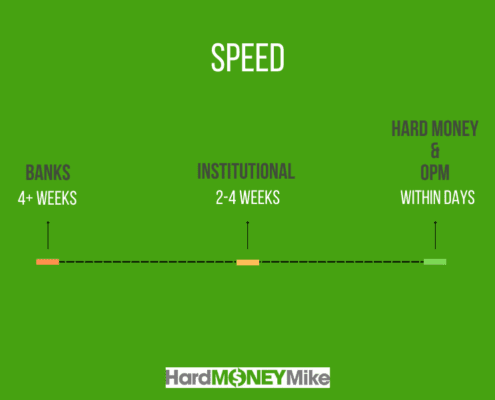
Typically, the fastest lending options will be hard money and real OPM. 

OPM is using real people’s money, from family, friends, or anyone with money to lend. If you build a relationship with the right OPM lenders, this can be your fastest funding option. OPM can be one phone call and bank transfer away.

Although more expensive, hard money lenders can save you money in the long run with the savings you get from closing quickly on wholesale properties. Hard money lenders can potentially get you money within days (sometimes quicker).

Institutional lenders are fairly quick, typically taking two or three weeks, sometimes four.

Banks are usually the slowest at four or more weeks (unless you already have a line of credit set up, like a HELOC).

2. Credit Score

Credit is a major factor in the loan process. Requirements for credit scores have gone up over the last few months as money tightens. 

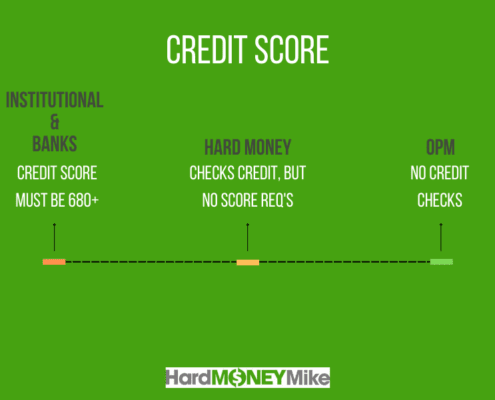
Institutions and banks have strict credit score requirements. The target for acceptable credit is constantly moving. Currently, you’ll have a tough time finding any loans with a score lower than 680. The best loans are available to people with a 740 and above.

Hard money lenders will check credit to make sure you’re not defaulting. But your actual score doesn’t have much bearing on your ability to get a loan.

OPM lenders aren’t as concerned with your actual credit score. OPM requirements will vary from person to person. But as long as you’re responsible in protecting their money, you can get an OPM loan.

3. Experience

Have you been in business for 2 years? Have you done enough transactions?

The toughest on experience are banks and institutional lenders.

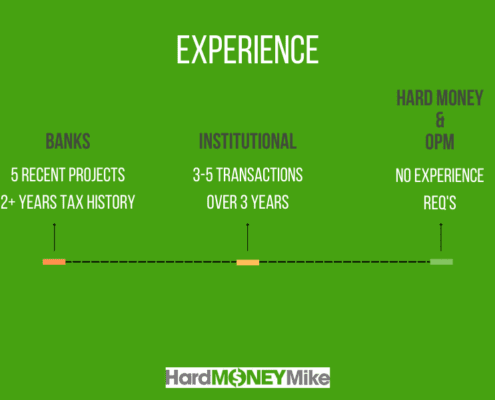
Institutional lenders typically require three to five transactions over a three-year period. They’ll still consider you if you have less experience than that, but they’ll need a higher down payment.

Banks are the strictest. They usually want you to have five completed projects in recent years, plus at least two years of tax history on investment properties.

Hard money and OPM are the easiest on experience.

Hard money lenders care that you have a profitable deal. OPM lenders care that they get a return on their money. Neither lender will be overly concerned with your experience level. They’re more understanding that “you gotta start somewhere.”

4. Income

What lenders are concerned with your debt ratio? 

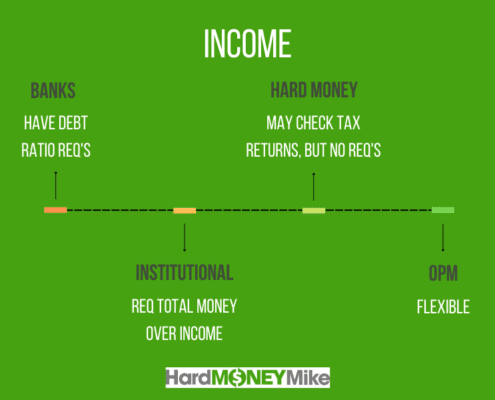
Banks are the only lenders that are always concerned with your income. 

Institutions look at the money you have in the bank, but not necessarily what you have coming in as income.

Hard money might look at your tax returns, but it won’t make or break your loan.

5. Underwriting

How does each lender look at your whole file? What is their criteria, and is it similar from lender-to-lender?

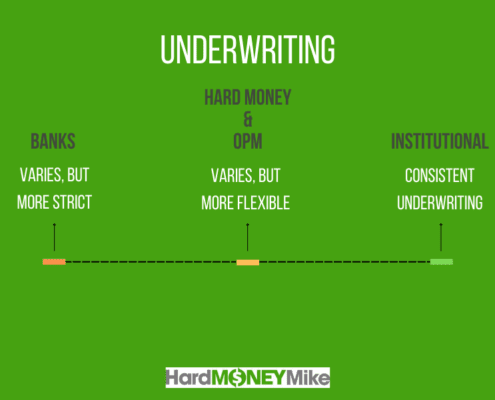
Institutional lenders have fairly consistent underwriting. They all basically require experience, 10 – 20% down, etc.

The other three types of lenders vary drastically.

Banks will always have some sort of requirements. But it’s different between large banks and small banks. Local banks will always be more interested in lending to investors.

Hard money and OPM both vary, too. You have to get to know the lenders in your area to get a feel for their requirements.

6. Flexibility

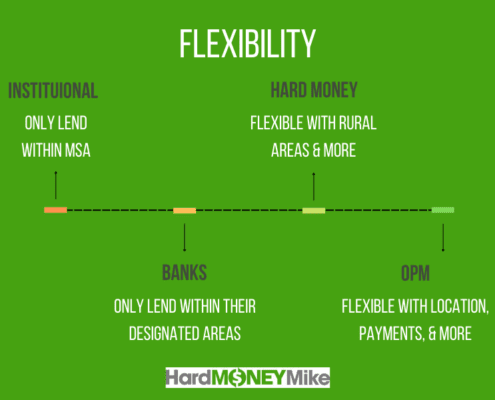
What if you need a loan for a rural property? Or what if some other unique situation pops up? Which lenders can be flexible with that.

Institutions and banks are the most fixed in what they offer. Institutional lenders loan only within MSAs. If a property is outside of city limits, they won’t offer any loans. Similarly, banks typically only lend within their footprint. You’ll have to talk to banks near you to learn those service areas.

Of course, hard money and OPM are more flexible with locations, funding plans, and more.

7. Pricing

Every loan has a cost.

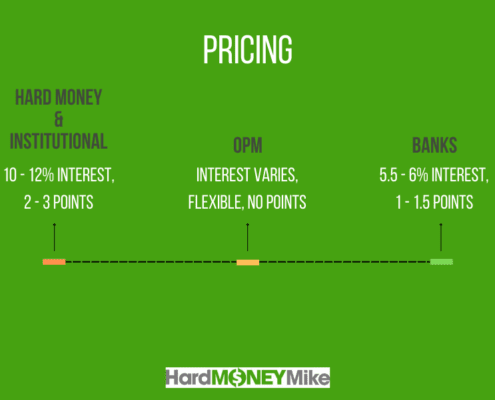
Bank loans have a lot of limitations, but this is where they shine. Interest rates and origination fees will almost always be lowest at banks. Interest rates average around 5.5 – 6%, and fees are around 1 – 1.5 points.

OPM is also pretty cheap, and more flexible than banks. Your interest rate will depend on your lender, but there are usually little to no points with real OPM.

Institutional and hard money lenders will be the most expensive, with interest rates around 10 – 12% and fees at 2 – 3 points.

8. Verified Funds

It makes sense that lenders want to know that you’ll have enough money to pay them back. But lenders go about verifying funds differently.

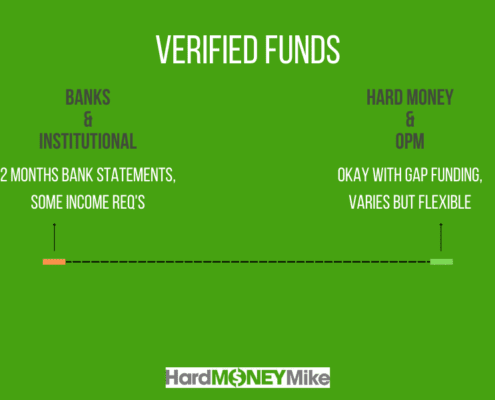
Institutions and banks typically require two months of bank statements. They want to prove you have the money for the down payment, rehab costs, and any carry costs. These lenders emphasize how much money you have and where it came from. They often don’t allow gap funding.

Hard money and OPM lenders, however, are fine with gap funding. These lenders’ requirements vary, but generally, funds are not a major consideration.

9. Funds Available

How much money does the lender have to offer? Do they ever run out of money, or tell you you’ll have to wait a couple weeks before they have funds?

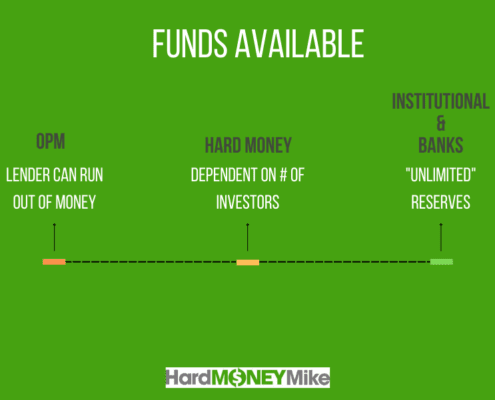
Typically, the places that have “unlimited” money are institutions and banks. Institutions are backed by Wall Street funds, and banks can always borrow from the Fed.

Hard money and OPM are a bit more limited. Hard money fund availability is based on how many investors they have. Real OPM is limited by the bank account of your lender. A downside of hard money and OPM is that money may run dry; there’s no guaranteed constant flow.

10. Multiple States

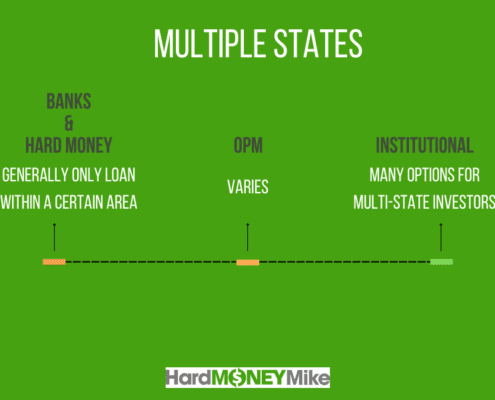
If you’re an investor who does deals in multiple states, who will be able to consistently help you? If you live in Oklahoma but invest in Texas, which lender can you count on?

Typically, institutions are your best bet for multi-state investments. If you need someone to grow with you state-to-state, this is your main option.

Many hard money lenders are local, and they focus their investments in a single community. Similarly, banks only lend within their region.

OPM’s multi-state lending ability depends on the client, but there is flexibility.

So What Is the Best Real Estate Loan?

All in all, there is no “best” real estate loan. Remember, you need all types of leverage for a flexible, lucrative investment career.

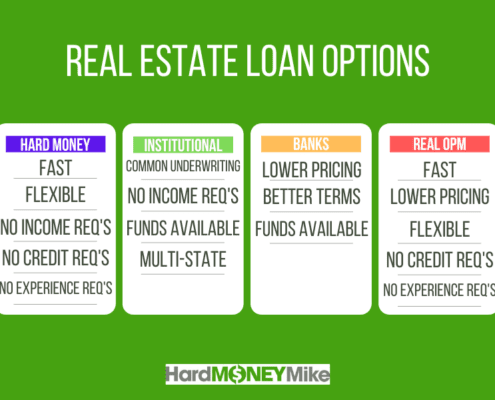
Each loan has its limitations and perks. Here’s a quick overview of each type of real estate loan.

More Info on Real Estate Loans

If you’re left with questions about the best leverage option for you, we’re here to help.

Email us at Mike@HardMoneyMike.com with questions about your deal.

Or join our weekly call here, every Thursday from 1:15 PM – 2:15 PM MST.

5 Times You Should Use Hard Money for Your Real Estate Investments

Here are 5 ways to use hard money right as a real estate investor.

Real estate investing is all about making profit.

And sometimes, to make profit, you need to use hard money loans.

When is hard money your best option in real estate investing? Let’s look at 5 situations where you should use hard money to fuel your investments.

1. Using Hard Money for Speed

The number one way hard money makes you money in real estate investing is how fast they are.

Look at a real example from one of our clients.

He was able to buy a property in Colorado at a $30,000 discount.

Five other people were bidding as high as $330,000 on the property.

But our client was able to close in less than a week, so the sellers accepted his bid of $300,000.

How Much Does a Hard Money Loan Cost?

People can get tripped up with the cost of hard money. Wouldn’t the price of the loan leave our client at a loss here? Let’s compare his hard money loan on this deal to his competitors with a bank loan.

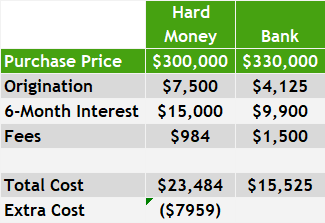
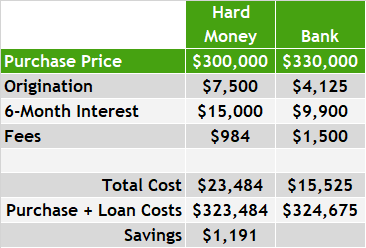
For hard money, he spent $7,500 on origination. A bank loan would have cost $4,500.

Six months’ worth of interest on the hard money loan adds up to $15,000. The same time on a bank loan would accrue $9,900 of interest.

Appraisal underwriting, and processing fees were lower with hard money at $984 (vs $1500 with the bank.)

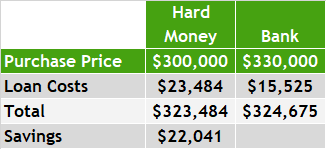
Overall, our client did pay a lot more for the loan itself using hard money. His hard money loan cost $23,484, and a bank loan would have cost $15,525. That’s an extra cost of $7,959 to use hard money.

Can You Save Money by Using Hard Money for Real Estate?

Despite seeming more expensive, hard money still gave this investor a discount. Why? Hard money enabled him to close fast, so he got a better deal on purchase price.

What was the total cost of hard money? The discounted price of the property ($300,000) plus the hard money loan costs equals $323,484. 

What about the bank loan? The home price of $330,000 plus bank loan costs totals $345,525.

This is a savings of $22,041. Just for closing fast with hard money rather than using the cheaper but slower bank loan.

Using hard money for speed works even when the discount is smaller.

Let’s say our client had bid only 10,000 less than the other investors. He still would’ve saved $1,191 up front on the deal.

Hard Money Savings without a Purchase Price Discount

The option of buying real estate with bank loans is often cheaper. However, in many investment situations, using a bank loan is not a viable option.

If you have to wait 4 weeks to clear your bank loan, but only 4 days for a hard money loan… that becomes the difference between closing on the property or not.

Ultimately, even if using hard money doesn’t get you the lowest price, you still save money in the long run. If the speed of a hard money loan gets you a property, you will still come out on top.

Buying then selling a profitable fix-and-flip will always make more money than never buying and never selling.

2. Use Hard Money if You Have Low Credit

Institutional lenders, private equity, and banks have credit score minimums. If you don’t have a high enough score, you don’t get a loan.

Hard money lenders, on the other hand, are typically not credit-score-driven. Yes, they’ll probably look at your credit, but they won’t base your loan on it.

Real estate investors can have low credit scores for many reasons:

  • Usage – You put your flip rehab costs on credit cards
  • Thin Credit – You have few lines of credit, or young lines of credit
  • One-time Event – You had good credit, then life happened and your score temporarily dipped.

Hard money lenders understand that these issues are not always a reflection of your ability to pay back loans. 

That’s why hard money lenders don’t worry about your credit score, just your credit.

Do you have a history of late payments? Are you defaulting? That will negatively affect you with a hard money lender. 

If you are responsible with credit, but have a score banks won’t accept, a hard money lender will be a good option.

3. Using Hard Money Because It’s Flexible

Sometimes you need an outside-of-the-box lender.

  • Unique Properties – If you have a house or area that’s unique (maybe a dome house, an old manufacturer, etc.), hard money lenders will give you more options.
  • Rural Areas – Most local banks and large hard money lenders don’t lend outside of MSAs. Traditional lenders might not cover thirty miles outside of an urban area, but many small hard money lenders will.
  • Cross Liens – Hard money lenders have more flexibility putting a cross lien on another property. This is useful if you don’t have a lot of money to put down, but do have another property with a lot of equity.
  • Gap funding – Sometimes a mortgage doesn’t quite cover all the costs of your project. Hard money can fill in those gaps.
  • Lot splits – Splitting off a lot can be a headache with a traditional lender. A hard money lender is more flexible with the time it takes to get a survey and everything else prepared. This allows you to split off a lot, sell the house, and keep the lot.

4. Using Hard Money for BRRRRs

Hard money is crucial for successful BRRRRs.

With BRRRR (rental flips), you:

  • Buy undermarket valued properties
  • With a hard money loan
  • Then rate-and-term refinance into a longer-term loan.

If you want to get into BRRRR transactions (rental properties), you have to find a hard money lender or private lender who will loan you 75-80% of the after-repair value of the property you want to buy.

If you get a hard money loan to fund the purchase price and rehab up to 75-80% ARV, you can maximize your refinance. This saves you money, time, and interest.

5. Other Times to Use Hard Money

There are many other reasons real estate investors use hard money. Here are a few:

  • Banks limit you to 2-3 loans. If you’ve maxed out those lenders, hard money can help.
  • Hard money can work as a bridge loan. It covers the down payment of your next property until your other bank-funded property sells.
  • You can keep a project off your credit. Hard money typically doesn’t show up on your credit report.
  • Investment beginners might need help with their first couple projects started before banks will lend to them.
  • Complete a started project. If you end up with a property mid-flip, many banks won’t lend for it. But a hard money lender can easily provide a gap loan to finish the rehab.
  • Hard money has the flexibility to let you come in with other funding sources. (If you want to put repair costs on a credit card, want to use an OPM lender, etc.).

How to Use Hard Money for Real Estate

Want to learn more about real estate funding? Wondering if a hard money loan might be right for your investment? 

Email us your questions anytime at Mike@HardMoneyMike.com

Or join our weekly Leverage Up call here, every Thursday from 1:15 PM to 2:15 PM (MST).

What Does ARV Mean in Real Estate Investing?

To profit in real estate investing, you’ll need to know: What does ARV mean?

Real Estate Investing: What Does ARV Mean?

ARV is the after repair value. It’s what the property will appraise for, or sell for, on the current market once the scope of work is completed.

You estimate a property’s ARV by looking at the prices of similar homes in the current market.

What Are Comps?

Comps (comparables) are those similar homes you look at. It’s important that your comps have the same value as your property.

For example, if your deal is for a 950 square-foot home, you’ll compare it to other 900 to 1,000 square-foot homes on the market, not a 2,000 square-foot one. Similarly, compare a 2-bedroom, 1-bath house to houses of the same specifications – not to 4-bedroom, 2-bath homes.

How To Get an Accurate ARV

For your ARV to be accurate, you need to stay true to your scope of work. If you only repaint and re-carpet a house that needed much more work, you won’t get top-of-the-market value when you try to sell or refinance.

On the other hand, if your scope of work is a full remodel, your comparables should be homes that are fully remodeled, so you don’t miss out on any profit.

The money you put into fixing up a house isn’t a direct indicator of how much the house will be worth. What the property looks like when it’s finished has nothing to do with how much it cost to get it there.

What Does ARV Mean for Profit in Real Estate Investing?

Estimated profit is what you expect to make on the transaction between:

  • buying the property
  • fixing it up
  • selling it again.

Additionally, equity is the difference between the amount you owe and what the property is worth. You build equity on your rentals by:

  • buying properties with a low purchase price and a high ARV
  • successfully refinancing after a flip
  • paying down the mortgage with rent income.

If you want to find the true profitability of a deal, then use your ARV and comparables:

ARV – (Purchase Price + Budget) = Profit Amount

Read the full article here.

Watch the video here:

https://youtu.be/4RErCDhSi44

The Power of Leverage: Are You Losing Money?

These simple examples show you the power of leverage in real estate investing.

Real estate investors know they need loans to buy properties. But few real estate beginners understand exactly how big of a difference leverage makes.

Leverage turns property-buying into a real estate investment career. It builds real money, and a portfolio of net worth that can create generational wealth.

In this article, we’ll use simple examples to break down the power of leverage in real estate – and how maximizing leverage skyrockets your real estate career.

What Is Leverage?

In short, leverage means buying with money that isn’t yours in order to make a profit.

Leverage takes the form of loans from lenders: banks, credit unions, hard money lenders, people you know.

The greatest tool for a real estate investor is leverage.

How to Find the Power of Leverage

Let’s look at some simple numbers to show the power of leverage.

We’ll look for two things:

1) How much income can you get from a rental?

2) How much equity will a property generate over time?

Note: We’re going to use $100,000 as our base number. That might be a lot more money than you have to start with. It’s also likely a lot less money than you’ll spend for your properties.

Regardless, it’s a simple number to show the power of leverage. These same principles will apply despite your starting number or your property costs.

Now, let’s dive in.

Income without Leverage vs with Leverage

Rent is the income you get from tenants. Net rent is that income after you’ve made any loan payments for the month on that property.

Net rent is the number that’s true cash flow for you. We’ll use this number to analyze real estate income with and without the power of leverage.

Income No Leverage

Say you have $100,000 to invest in real estate.

You could take this money and buy one rental property valued at $100,000. You can invest the full $100,000 and receive $1,200 of net rent income per month, or $14,400 per year.

Income With Leverage

Now let’s see how it plays out when you involve a lender rather than buying outright.

You could talk to a lender who might offer to loan you $75,000 if you put in the other $25,000. Now, instead of pouring all of your money into one rental property, you’ll only have to use $25,000. The $75,000 covered by the lender is considered leverage.

Using lenders like this, you could buy four properties, each with a $25,000 down payment. Because you’re paying a mortgage, however, your net rent per month goes down. Your net rent is now $750 per property. This brings in $3,000 per month, or $36,000 per year.

With leverage, you have the potential to make $1,800 per month more, or an additional $21,600 per year – just from using leverage.

Net Worth without Leverage vs with Leverage

Rent income isn’t the only financial outcome of buying and renting real estate. There’s also appreciation. 

According to the stats over the last 20 years, real estate goes up an average of 5.3% per year. Using this 5.3% number, one home increases value by an average of $5,000 per year. 

This isn’t a straight line (ie, exactly $5,000 per year). Some years may appreciate more, some less. But over the long-term, that’s the average yearly appreciation, so we’ll use this number.

Net Worth No Leverage

Let’s see how appreciation would impact our real estate portfolio had we bought the one home outright, with no leverage.

Our single rental would have $5,000 in equity after one year, $25,000 after five years, and $150,000 after 30 years.

Net Worth with Leverage

Now let’s see the equity of the four properties purchased with leverage. 

Each of the four homes increases in value by $5,000 every year. Multiply that by four, and your portfolio appreciates $20,000 per year.

Over a 30-year span, your four properties would add $650,000 to your net worth (compared to $150,000 with the single property).

Total Power of Leverage

Let’s put all these numbers together now.

Using leverage brought in an extra $21,600 of income per year,  plus a total net worth increase of $600,000 over 30 years.

This is the power of leverage: bringing in extra income and raising your net worth through equity.

By using other people’s money, you can take advantage of the true wealth in real estate.

Maximizing Leverage

Now, we’ll take this example one step further. Simply using leverage unlocks a lot of money. What happens when you maximize leverage?

We looked at an example of a lender giving you 75% ($75,000 on a $100,000 property). “Maximizing” that leverage would look like getting a bigger loan. Instead of 75%, another lender might give you 80-85%.

80% Leverage

Let’s go back to the original example, but say a bank gives you 5% more. Now, you get $80,000 per $100,000 transaction.

Income with Maximized Leverage

Your down payment per property is now only $20,000, so you can buy 5 properties. But since you borrowed more money, the mortgage payment is higher, and the net rent goes down.

At this point, it may seem like you’re set up to make less money since you’re paying more on your loan. But let’s see how it plays out.

Five properties with an income of $700 per month is $3,500 per month. This works out to be $42,000 per year. Annually, that’s $6,000 more than using a 75% loan, and $27,600 more than using no leverage at all.

Equity with Maximized Leverage

For five properties, after 30 years, equity appreciates by $750,000. All that money is added to your net worth.

Maximizing your leverage in this scenario would give you $42,000 in yearly income, plus $750,000 added to the value of your properties over time.

That’s the road to generational wealth.

How to Maximize Leverage

To maximize your leverage, focus on becoming the sort of investor that attracts lenders.

Have a great credit score. Make sure your income is in line. Know the numbers lenders will ask about. Be professional about your investment career.

Having all the right pieces in place will help your leverage take you further. The more leverage you use, the better returns you’ll see – both in the short-term income and long-term equity.

Harnessing the Power of Leverage

Now you can see how leverage impacts your real estate career. 

What are your next steps?

If you need an entry point into real estate investment, email Mike@HardMoneyMike.com. Ask about our 30-day fuel up challenge to learn how to maximize your leverage.

You can also join our weekly Leverage Up chat, on Thursdays from 1:15pm – 2:15pm MST at this link.